




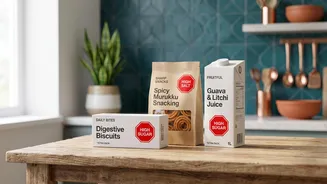


What's Changing on Your Food Packs?
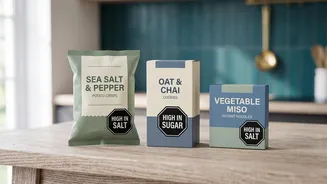
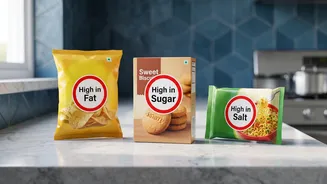
The Food Safety and Standards Authority of India (FSSAI) is rolling out a new system called Front-of-Pack Nutrition Labelling (FoPL). Soon, you will start seeing a distinct red hexagon on the front of many packaged goods. This label will act as a quick
visual warning, clearly stating if a product is 'High in Sugar', 'High in Salt', or 'High in Fat'. The idea is to make crucial health information impossible to miss, helping you make faster, more informed decisions without needing to hunt for the fine print on the back of the package.
The Public Health Push Behind the Labels
This major shift isn't happening in a vacuum. It's a direct response to growing public health concerns in India, where unhealthy diets are linked to a significant portion of the country's disease burden. With rising rates of obesity and non-communicable diseases, health experts and the Supreme Court have pushed for more transparency from food manufacturers. The new warning labels are designed to cut through marketing claims like 'healthy' or 'natural' that can sometimes be misleading, giving consumers a clear, science-based indicator of nutrients that should be consumed in moderation.
A Tougher Stance for Clearer Choices
The journey to these new labels has involved considerable debate. Early proposals for a star-rating system were set aside in favour of direct warning labels, a method that has proven effective in other countries. FSSAI has recently toughened its stance, proposing a single-phase rollout where a warning will be triggered if a product exceeds the threshold for even one of the specified nutrients—sugar, salt, or fat. Previously, the plan was to only label products that were high in at least two of these nutrients, a move criticised by health advocates as too lenient. This stricter approach, which has the backing of the Supreme Court, aims to provide maximum clarity for consumers.
How to Read and Use the New Warnings
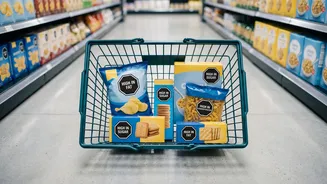
When you see the red hexagon, it will contain simple text like 'High in Sugar'. If a product is high in multiple nutrients, they will all be listed within that single hexagon. The thresholds are based on the Dietary Guidelines for Indians, 2024, from the Indian Council of Medical Research-National Institute of Nutrition (ICMR-NIN). For shoppers, this means being able to compare two similar-looking products—like breakfast cereals or snacks—and instantly see which one has a higher content of salt, sugar, or fat. This doesn't automatically mean a food is 'bad', but it provides an essential piece of information to help balance your diet.
Industry Concerns and the Road Ahead
The food industry, while not entirely opposed to the idea of front-of-pack labels, has raised concerns. Some industry associations have argued that the red colour could be confused with the symbol for non-vegetarian products and have debated the nutrient thresholds and the use of a standard 100-gram benchmark for calculation instead of serving size. Despite this, the FSSAI is moving forward, with the Supreme Court questioning delays and urging swift implementation for the good of the nation's health. The regulator has requested a few months to finalise the draft regulations, after which companies will be given a period to comply.