
A Cosmic Size Problem
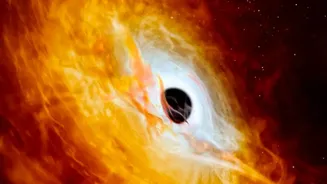
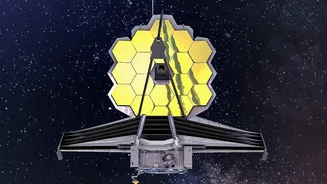
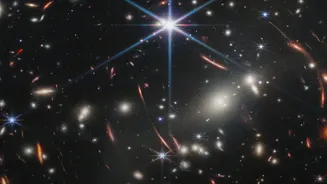
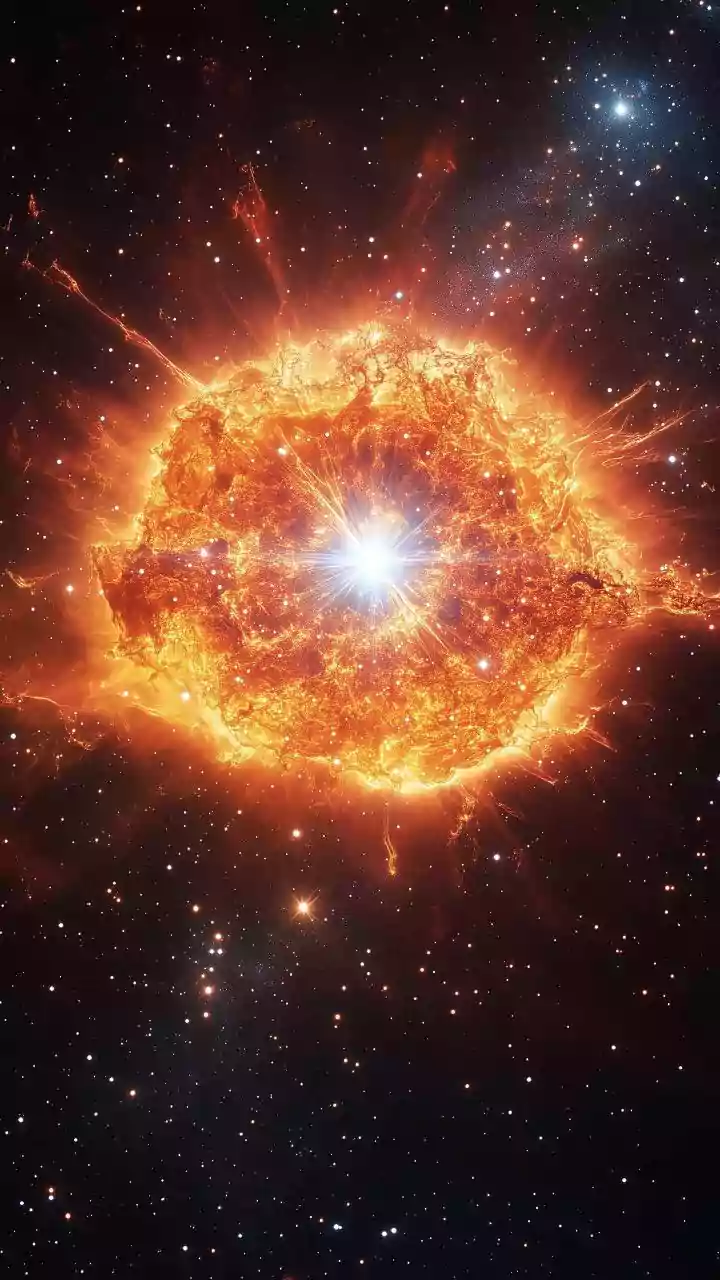
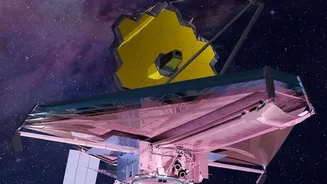
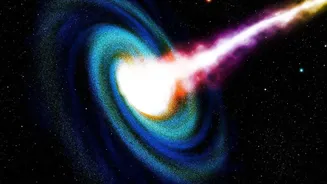
Since it began operations, the James Webb Space Telescope (JWST) has been spotting supermassive black holes (SMBHs) that existed when the universe was less than a billion years old. The problem is their size. Some of these ancient giants are billions
of times the mass of our Sun, and in some cases, their mass is a huge fraction of their entire host galaxy — sometimes 10% or more. This is baffling because in the modern universe, a typical SMBH is only about 0.1% of its galaxy's stellar mass. It's like finding a newborn baby that weighs as much as a full-grown adult; it defies the known rules of growth.
The Race Against Time
According to our long-held theories, black holes grow in two main ways: by gradually pulling in surrounding gas and dust, and by merging with other black holes. Both of these are slow processes. For a black hole to reach a billion solar masses, it needs a lot of time to feed and merge. The discovery of such massive objects just a few hundred million years after the Big Bang presents a severe timing crunch. There simply doesn't seem to have been enough time for them to have grown so large through these conventional methods. This forces astronomers to ask a fundamental question: was something different about the early universe?
Were the Seeds Heavier?
One leading idea is that the initial 'seeds' of these black holes were much larger than we thought. The standard model posits that the first black holes were 'light seeds', forming from the collapse of the universe's first massive stars, weighing in at around 10 to 100 times the mass of our sun. But to solve the growth puzzle, some scientists propose the existence of 'heavy seeds'. This theory suggests that huge clouds of primordial gas could have collapsed directly into a black hole, skipping the star phase entirely. Such an event could create a starting black hole already weighing 10,000 to 100,000 times the mass of the Sun, giving it a crucial head start.
Galaxies Forming Around Black Holes?
Another radical idea flipped the script entirely. Traditionally, it was thought that galaxies form first, and the supermassive black holes at their centres grow with them. But some of these early black holes observed by Webb appear 'nearly naked', with very sparse galaxies around them. This has revived a theory once championed by Stephen Hawking: primordial black holes. In this scenario, black holes didn't come from stars but were formed from dense clumps of matter in the first moments after the Big Bang itself. These ancient black holes would have then acted as gravitational anchors, with the first galaxies forming around them.
A Universe of New Questions
The discoveries from JWST, including pairs of giant quasars and mysterious 'Little Red Dots' that may be overmassive black holes, are creating more questions than answers. Some recent research even suggests that dense, compact star clusters in the early universe could have led to runaway stellar collisions, creating intermediate-mass black holes that acted as the seeds. Each new observation adds a piece to the puzzle. The consensus is that our standard model of how the universe's largest structures form and evolve is incomplete. The universe, it seems, had ways of building giants much faster than we ever imagined.