
The Cosmic Chemical Test
A biosignature is any substance, feature, or phenomenon that provides evidence of past or present life. In the search for life on distant exoplanets, scientists focus on atmospheric biosignatures. These are gases that accumulate in a planet's atmosphere
to levels that would be unlikely without a biological source constantly replenishing them. On Earth, for example, the abundance of oxygen is a direct result of photosynthesis by plants and microbes. Similarly, much of the methane in our atmosphere is produced by living organisms. Finding these kinds of chemical imbalances on another world could be a powerful sign that something is alive there.
How to Read Alien Air
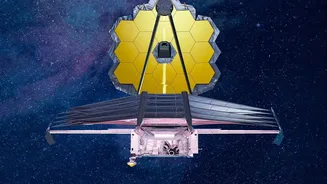
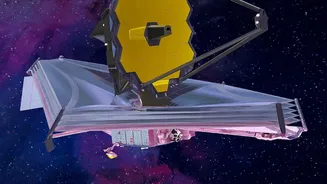
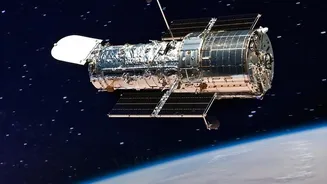
The primary tool for this long-distance analysis is the James Webb Space Telescope (JWST). Scientists use a technique called transit spectroscopy. When an exoplanet passes in front of its host star, a tiny fraction of the starlight filters through the planet's atmosphere. Different gases absorb specific wavelengths of light, leaving a unique chemical "barcode" in the starlight that reaches the telescope. By analyzing this spectrum, astronomers can deduce the chemical composition of that alien world's air, searching for molecules like oxygen, methane, carbon dioxide, and others that might hint at life.
The Challenge of False Positives
Detecting a promising gas is not proof of life. The biggest challenge in this field is the problem of false positives, where non-biological processes can mimic the signs of life. Methane can be released by geological activity like volcanoes. A planet's atmosphere could even build up oxygen through photochemical reactions without any life at all, especially around certain types of stars. For this reason, scientists are cautious. The gold standard is not just finding one gas, but a specific combination of gases that are in chemical disequilibrium—like finding both oxygen and methane coexisting, which on Earth only happens because life is constantly producing both. Ruling out all possible non-biological explanations is a critical, and difficult, step.
A Second Data Point for Life
This is where the search for extraterrestrial life loops back to teach us about our own origins. The process of life emerging from non-living matter, known as abiogenesis, is one of science's biggest mysteries because we only have one example: Earth. Finding even a single, confirmed instance of life on another planet would be revolutionary. It would provide a second data point, moving the origin of life from a seemingly unique event to a potentially common process in the cosmos. The very detection of a biosphere would falsify the theory that life's beginning was a vanishingly unlikely fluke.
From Detection to a Blueprint for Beginnings
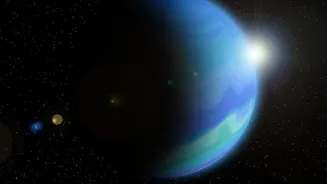
If we detect a robust biosignature, such as on the much-discussed exoplanet K2-18b where hints of dimethyl sulfide (a gas produced only by life on Earth) have been tentatively reported, we can study that world's environment in detail. We can analyze its distance from its star, its size, and the other chemicals present. This context is crucial. Does life arise in a global ocean on a 'Hycean' world like K2-18b is hypothesized to be? Or on a rocky world more like Earth? By correlating the presence of life with specific planetary conditions, we can begin to test theories about what is required for abiogenesis—the right ingredients, the right energy from a star, the presence of liquid water. Each discovery would help us refine our understanding of the environmental conditions that allow life to spark and take hold, providing clues about the path from chemistry to biology that occurred on our own young planet.