
A Storm Unlike Any Other
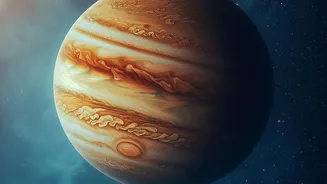
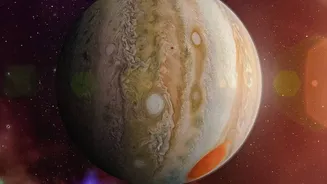
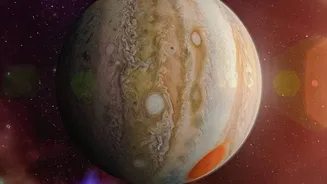
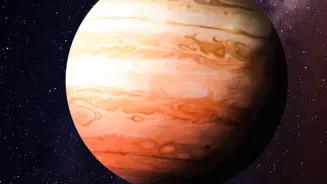
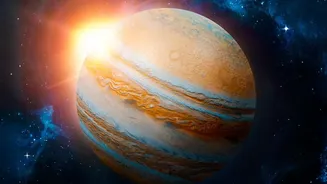
For at least 150 years, and possibly much longer, astronomers have tracked the Great Red Spot. It’s a high-pressure system, technically an anticyclone, with winds that can reach staggering speeds. Unlike storms on Earth that form over water and dissipate
over land, this Jovian tempest has no solid surface to slow it down, allowing it to rage for centuries. It's so large that historically it could have swallowed three Earths, though it has been shrinking for decades. This long-term change has made it an object of intense scientific curiosity. Its iconic colour, which can vary from a deep red to a pale orange, is another long-standing mystery, possibly caused by chemicals deep within the storm being exposed to sunlight in the upper atmosphere.
What the New Images Reveal
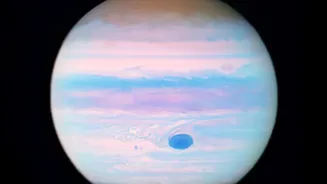
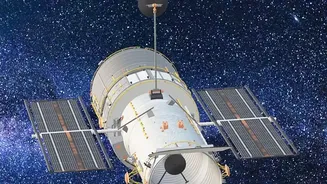
Recent observations from advanced planetary imaging instruments, like those aboard the Hubble Space Telescope, have given us our most detailed look yet inside the storm. These new captures show that the Great Red Spot is far from a stable, steady vortex. Instead, it appears to be behaving with unexpected turbulence, jiggling and oscillating in shape over a 90-day cycle. Scientists were surprised to see the storm's shape squeeze and stretch, and its rotation speed up and slow down within this period. High-resolution views have also identified smaller eddies and filaments at the storm's edge, some of which appear to be feeding into the main vortex, while others look like flakes peeling away from the central mass.
The Mystery of the Shrinking Spot
The incredible new details arrive as the Great Red Spot continues its well-documented, century-long shrinking trend. In the late 1800s, the storm was estimated to be over 40,000 kilometers wide. By the time NASA's Voyager probes flew past in 1979, it had shrunk to about 23,000 kilometers. Today, it's just over 16,000 kilometers across, barely wide enough to fit one Earth. These new findings of internal oscillations and interactions with smaller storms add fresh complexity to the puzzle. Some scientists now hypothesise that a change in its 'diet' of smaller storms, which it consumes to maintain its energy, could be contributing to its downsizing. The new data on its internal dynamics will be crucial for testing these theories.
The Technology Behind the View
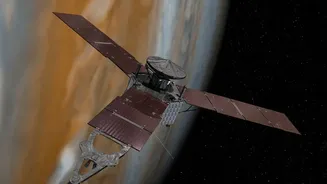
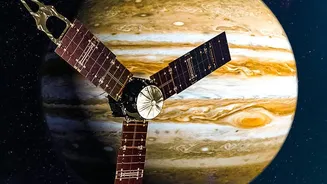
Getting such a clear view of a storm hundreds of millions of kilometers away requires incredible technology. Programs like the Outer Planet Atmospheres Legacy (OPAL) use the Hubble Space Telescope to conduct yearly check-ups on the outer planets. These powerful cameras can capture images in different light spectrums, including ultraviolet, revealing details invisible to the naked eye. In addition, NASA’s Juno spacecraft, in orbit around Jupiter, uses its suite of instruments to probe beneath the cloud tops, gathering data on the storm's temperature and structure at different depths. It’s the combination of these advanced tools that allows scientists to build a more complete, three-dimensional picture of how the Great Red Spot truly functions, from its deep roots to its cloudy surface.
Why Jupiter's Weather Matters Here on Earth
Studying Jupiter is more than just planetary tourism. The gas giant acts as a massive natural laboratory for fluid dynamics, the physics of how liquids and gases move. Understanding the forces that power a storm as long-lived and massive as the Great Red Spot helps scientists refine their models of atmospheric physics. These principles don't just apply to other planets; they help us understand the fundamentals of weather systems everywhere, including the hurricanes and cyclones on our own world. As we discover more planets around other stars, insights from Jupiter provide a crucial reference point for understanding the potential weather on these distant exoplanets, making the study of our own solar system neighbour more important than ever.