



The Target: A Whisper from 13 Billion Years Ago
The target is not just any signal; it's the faint radio echo of the “Cosmic Dawn.” This period, from about 50 to a few hundred million years after the Big Bang, is when the very first stars and galaxies ignited, ending the cosmic 'dark ages'. Before these
first stars, the universe was filled with a vast, neutral cloud of hydrogen. As the first stars switched on, their light began to ionize this gas, a process that left a specific imprint. Astronomers are hunting for a signal produced by this neutral hydrogen, known as the 21cm line. This isn't a bright, flashing light but a subtle change in the radio spectrum. Due to the expansion of the universe over 13 billion years, this 21cm wavelength has been stretched to several metres, shifting it to the low-frequency radio band that the SKA is designed to capture.
The Challenge: A Cosmic Needle in a Galactic Haystack
Detecting this ancient signal is monumentally difficult. The primary obstacle is noise. The faint 21cm signal is buried under radio emissions from our own Milky Way galaxy and other cosmic sources that are thousands, or even millions, of times brighter. It's like trying to see a single candle from kilometres away while someone is shining a stadium floodlight directly in your eyes. On top of this galactic noise, there's interference from Earth-based sources like radio broadcasts and mobile communications, which can easily swamp the delicate cosmic whisper. The Earth’s own ionosphere can also distort these low-frequency signals as they pass through. Isolating the true signal requires not only extreme sensitivity but also an almost perfect understanding of the telescope itself and all the foreground noise to subtract it accurately.
The Tools: A Symphony of Dishes
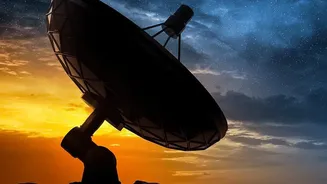
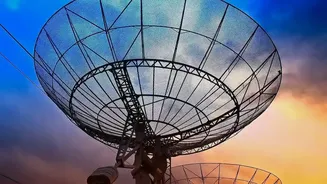
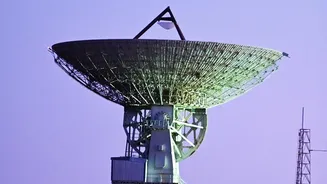
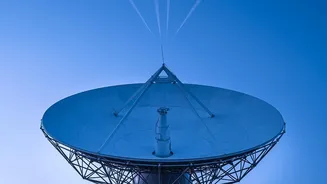
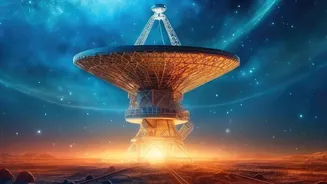
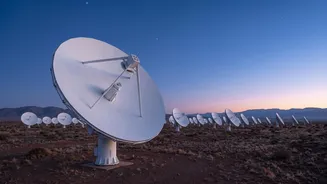
The headline's "deep-space dishes" refer to the SKA-Mid telescope, currently under construction in South Africa's Karoo region. This part of the SKA will eventually consist of 197 precisely engineered parabolic antennas, incorporating the existing 64-dish MeerKAT array. Each 15-metre dish has a surface accuracy smoother than the width of a human hair, ensuring that faint radio waves are focused correctly. But the real power comes from using them together through a technique called interferometry. By combining the signals from dishes spread over distances up to 150 kilometres, the array acts as a single, gigantic telescope. This not only dramatically increases sensitivity (its ability to detect faint objects) but also provides the high resolution needed to map the sky in fine detail. Construction on the project is well underway, with major components being manufactured and assembled.
Location, Location, Radio Location
To even stand a chance of hearing the Cosmic Dawn, you need silence. That's why the SKA-Mid dishes are located in the Karoo desert of South Africa, one of the most radio-quiet places on Earth. This remote location offers natural protection from the radio frequency interference (RFI) that plagues modern life. The site is a legally protected Radio Quiet Zone, with strict controls on activities that could produce interfering signals. For astronomers, this quiet environment is just as crucial as the hardware itself. It reduces the amount of 'man-made static' that the telescopes' powerful computers have to filter out, making the task of finding the cosmological signal just a little bit easier. The view of our own Milky Way galaxy is also optimal from the Southern Hemisphere, a key factor in site selection.
From Raw Data to Cosmic Discovery
Even with the best dishes in the quietest location, the final step is a computational marathon. The SKA will generate more data than the entire global internet traffic of today. This colossal data stream is sent via optical fibres to a Central Signal Processor. Here, powerful supercomputers perform the critical task of correlation, combining the data from each individual dish. Following this, scientists will use sophisticated algorithms to clean the data, meticulously identifying and subtracting the overwhelming radio foregrounds from our galaxy and the instrumental noise. Only after this intense digital filtering can the faint, stretched-out 21cm signal from the Cosmic Dawn be revealed. It is within this cleaned data that astronomers hope to create the first three-dimensional maps of the early universe as it was first being lit up by stars.