





The Sun’s Unseen Engine Room
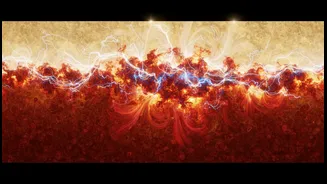
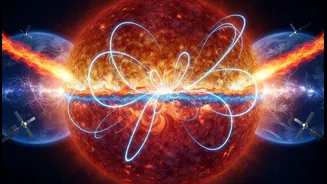
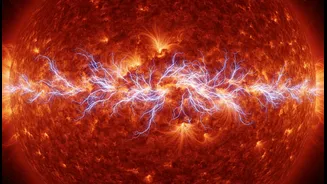
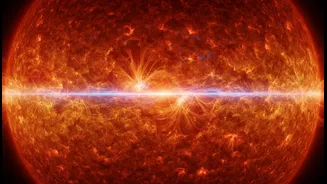
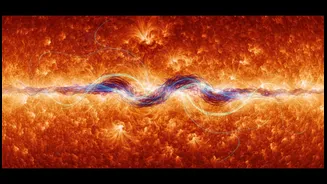
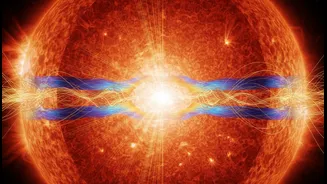
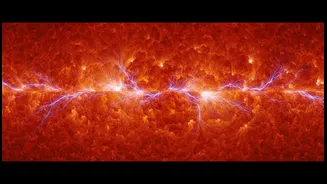
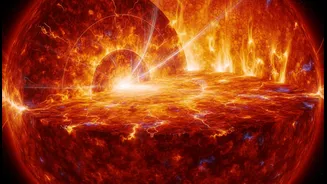
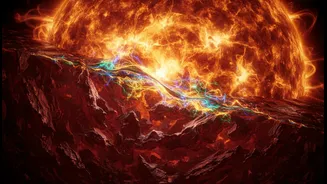
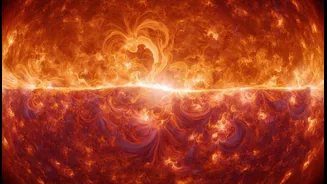
The Sun, our seemingly steady star, has a chaotic and mysterious interior. A crucial part of this mystery is the tachocline, a vast transition layer located roughly 200,000 kilometres beneath the visible surface. It's a place of immense shear, where the Sun's
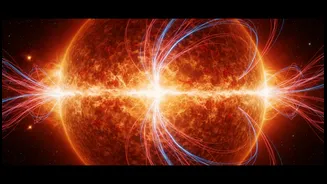
inner radiative zone, which rotates like a solid ball, meets the outer convection zone, where different latitudes rotate at different speeds. This violent interface is believed to be the primary dynamo generating the Sun's powerful magnetic field. These magnetic fields are the source of sunspots, solar flares, and coronal mass ejections (CMEs)—the very phenomena that constitute 'space weather'. Understanding the tachocline is therefore critical to predicting solar storms that can have devastating effects on our technologically dependent society.
A Leap Forward in Solar Prediction
For decades, space weather forecasting has been a challenging field, often providing warnings only a few hours or days in advance. However, recent advancements in helioseismology—studying the Sun's interior by observing waves on its surface—and sophisticated computer modelling are beginning to change the game. Scientists are developing new models, some powered by artificial intelligence and machine learning, that can better interpret the complex dynamics of the tachocline. These improvements are moving beyond simply observing surface features like sunspots and are starting to incorporate the deep physics of the solar dynamo. The goal is to move from short-term reactions to long-range predictions, potentially giving weeks or even months of warning for significant solar activity.
What 'Operations' Really Means
When we talk about translating forecasts into 'operations', we're referring to the real-world actions taken by various industries to protect critical infrastructure. For satellite operators, it means adjusting orbits to avoid increased atmospheric drag or powering down sensitive electronics to prevent damage from radiation. For the aviation industry, it involves rerouting polar flights to avoid communication blackouts and high radiation doses for crew and passengers. For electric grid managers, it's about preparing for geomagnetically induced currents (GICs) that can overload transformers and cause widespread blackouts. These are high-stakes decisions where a wrong call—either acting on a false alarm or failing to act on a real threat—can cost millions and disrupt society.
The Implementation Bottleneck
Herein lies the critical lag described in the headline. A new scientific model, even one with promising results, cannot be plugged into operational systems overnight. First, it must be rigorously validated over a long period. Operators of multi-billion dollar satellite constellations or national power grids need to be certain that a new forecast model is consistently reliable and an improvement over existing methods. There is a significant gap between what a research model can do and what an operational model is trusted to do. This process involves extensive testing, peer review, and a gradual building of trust. Furthermore, changing operational procedures is a complex and expensive undertaking, often involving regulatory hurdles and the retraining of personnel. The mantra in critical infrastructure is stability and reliability, which makes the adoption of new, unproven technologies inherently slow.
Bridging the Gap from Science to Safety
Closing the gap between cutting-edge science and operational readiness is a major challenge in the space weather community. It requires a more robust process for transferring research models into the hands of operational forecasters, a goal that national and international bodies are actively working on. This involves creating dedicated testing environments where new models can run in parallel with old ones to prove their worth. It also means fostering closer collaboration between academic researchers and the industries that rely on their work. As machine learning and AI-driven models become more prevalent, the ability to interpret their 'black box' decisions and quantify their uncertainty will be crucial for gaining the trust of operators who are ultimately responsible for public safety and economic stability.