



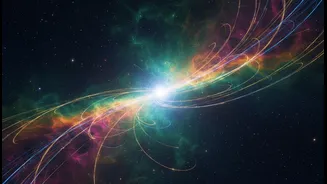


Cosmic Lighthouses in the Deep
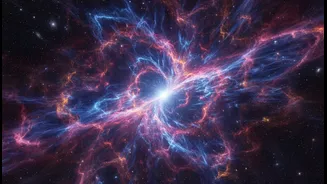
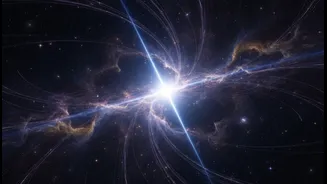
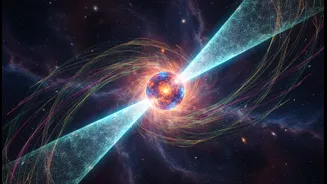
To understand this new map, we first need to talk about pulsars. A pulsar is the incredibly dense, spinning corpse of a massive star that exploded in a supernova. What’s left is a city-sized sphere so dense a spoonful would weigh as much as everyone on Earth
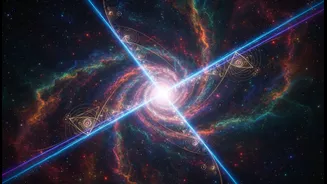
combined. These stellar remnants spin at breathtaking speeds, some hundreds of times per second. As they spin, their powerful magnetic fields channel beams of radiation, like X-rays and radio waves, from their poles. If one of these beams happens to sweep past Earth, we see a regular 'pulse' of energy. This is why astronomers call them cosmic lighthouses; their steady, predictable flashes provide a reliable beacon across vast cosmic distances.
The Invisible Galactic Web
The space between stars isn't empty. It’s filled with a tenuous mix of gas, dust, and charged particles called the interstellar medium. Woven throughout this medium is a vast, complex web of magnetic fields. These fields are hugely important; they help shape how galaxies evolve, guide the formation of new stars, and steer high-energy cosmic rays. Yet, because they are invisible, mapping them is incredibly difficult. Scientists have historically struggled to get a comprehensive, three-dimensional picture of this fundamental force. Early methods could only measure the field along a single line of sight at a time, making it a slow, painstaking process.
Using Light to See Magnetism
This is where pulsars come to the rescue. The light from these cosmic beacons is polarized, meaning it travels in a specific orientation. As this polarized light journeys through the interstellar medium, the galaxy's magnetic fields twist it. This phenomenon is known as Faraday rotation, and it has been understood for over 150 years. The amount of twist directly relates to the strength of the magnetic field the light passed through. By measuring the radio signals from thousands of pulsars spread throughout the galaxy, astronomers can measure the twist for each one. Since the distance to many pulsars is known, scientists can combine all these individual lines of sight to build up a 3D map of the magnetic field structure. Think of it like seeing how a thousand different ship's lights are distorted by fog to map out the densest parts of the fog bank.
NASA's Precision Instruments
Creating this map requires incredibly precise measurements, which is where NASA's technology plays a key role. A crucial tool is the Neutron star Interior Composition Explorer (NICER), a telescope mounted on the International Space Station. NICER can time the arrival of X-rays from pulsars with a precision of better than one hundred nanoseconds. This level of accuracy allows for incredibly detailed studies of pulsars themselves, and it feeds into the larger effort of mapping the forces that surround them. While the term "Lighthouse Pulsar Map" refers to the overall method, missions like NICER and radio observatories on the ground provide the raw data that makes this new view of the galaxy possible. This technique is so precise it's also being tested as a form of galactic GPS for future spacecraft navigation.
A New Era for Astrophysics
So, what does this change? For one, it provides the first detailed, large-scale maps of the magnetic architecture of our Milky Way. This allows scientists to test theories about how galactic dynamos, the cosmic engines that generate these fields, actually work. It also helps us understand the environments around some of the universe's most extreme objects: magnetars. These are a special type of neutron star with magnetic fields a quadrillion times stronger than Earth's. By understanding the broader galactic field, scientists can better isolate and study the colossal magnetic forces raging around these unique objects. This new ability to chart the unseen is giving us a more complete picture of the cosmos, revealing the powerful, invisible structures that govern the lives of stars and galaxies.