



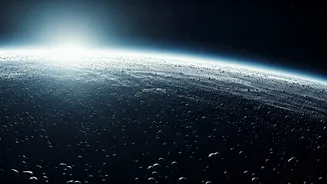



The Planet in Question: Mercury
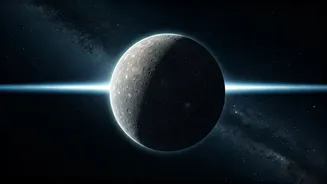
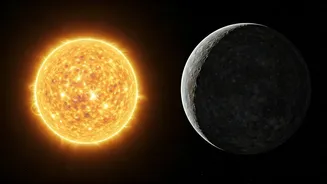
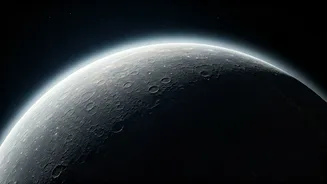
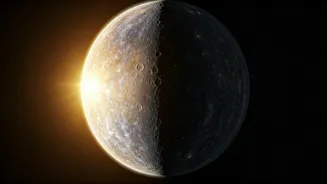
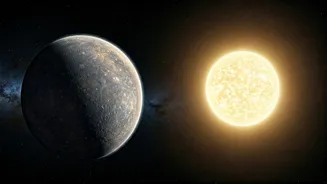
The planet with this mind-bendingly long day is Mercury, the smallest planet in our solar system and the one closest to the Sun. For a long time, astronomers believed Mercury was 'tidally locked' to the Sun, meaning one side always faced it, much like
our Moon is tidally locked to Earth. This would have meant its day was the same length as its year. However, radar observations in the 1960s revealed a much stranger and more interesting reality. Mercury isn't locked, but it is in a very special kind of slow dance.
A Day Isn't Just a Day
The headline's 'fifty-nine days' refers to what scientists call a 'sidereal day'. This is the time it takes for a planet to complete one full 360-degree rotation on its axis relative to the distant stars. For Mercury, this takes about 58.6 Earth days. Simple enough, right? But that's not what a day *feels* like on the surface. For that, we need to look at the 'solar day' — the time it takes for the Sun to return to the same position in the sky. Because Mercury is also zipping around the Sun so quickly (its year is only 88 Earth days long), its solar day is vastly different. From sunrise to sunrise on Mercury, a staggering 176 Earth days will have passed. That means a single day on Mercury is longer than two of its years!
The 3:2 Spin-Orbit Dance
So, why the weird numbers? It’s because Mercury is in what's called a 3:2 spin-orbit resonance. This means that for every two orbits it completes around the Sun, it rotates on its axis exactly three times. This isn't a coincidence. Over billions of years, the Sun's immense gravity has tugged on Mercury, which is not perfectly spherical. This gravitational pull acted like a brake, slowing down Mercury’s initially faster rotation until it settled into this stable, resonant pattern. It’s the most energy-efficient state for the planet to be in, a delicate gravitational harmony sculpted over aeons. Think of it like pushing a child on a swing; you get the best result by pushing at just the right moment in the swing's cycle. The Sun does the same to Mercury with its gravity.
Life in the Slow Lane
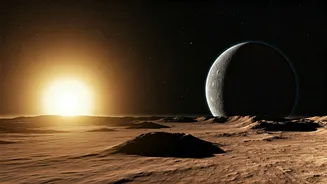
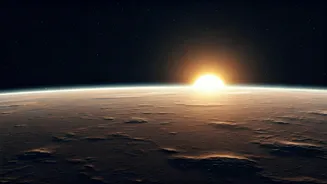
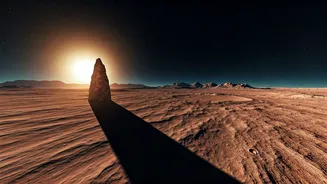
Living through a Mercurian day would be a truly bizarre experience. With a sunrise happening only once every 176 Earth days, the surface is exposed to the Sun's intense, unfiltered radiation for months at a time. This causes surface temperatures to soar to a scorching 430 degrees Celsius, hot enough to melt lead. Then, during the equally long night, with no thick atmosphere to trap heat, temperatures plummet to a freezing -180 degrees Celsius. This creates one of the most extreme temperature swings in the entire solar system. Even stranger, because of the interplay between its slow rotation and fast orbit, the Sun would appear to rise, stop, move backwards for a bit, and then continue its journey across the sky.
Why We Study These Extremes
Understanding planets like Mercury helps us understand the fundamental physics of how solar systems form and evolve. These 'weird' planets are not just cosmic oddities; they are natural laboratories that test the limits of our theories about gravity, planetary formation, and orbital mechanics. Missions like NASA's MESSENGER and the current ESA/JAXA BepiColombo mission are designed to peel back Mercury's secrets, mapping its surface and studying its magnetic field and tenuous atmosphere. By studying the planet that lives in the Sun's glare, we learn more about the conditions that make a planet like ours, with its comfortable 24-hour day, so perfectly suited for life.