





The Familiar Favourite: Packing Cubes
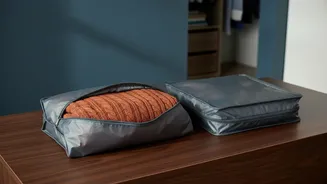
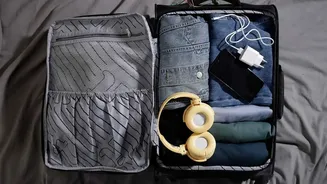
Packing cubes are the undisputed champions of luggage organization. These zippered fabric containers come in various sizes, allowing you to neatly compartmentalize your clothing. T-shirts go in one, socks and underwear in another, and trousers in a third.
This system makes finding what you need without ransacking your entire suitcase a breeze. Some versions, known as compression cubes, feature an extra zipper that squeezes the cube to reduce its volume. However, this compression is limited; it mainly tamps down the fabric rather than truly removing excess air. For general organization and modest space-saving, they are fantastic. But when faced with truly bulky items, their limitations become apparent.
The Challenger: Air Extraction Pouches
Enter the air extraction pouch, also known as a travel roll-up compression bag. Think of them as a travel-friendly version of the vacuum-seal bags you might use for storing duvets at home. Instead of needing a vacuum cleaner, these pouches are designed with a one-way valve system. You place your items inside, seal the zip-top closure, and then tightly roll the bag from the sealed end. This action forces all the trapped air out through the valve at the other end, but doesn't let any back in. The result is a dramatically flattened, compact package.
The Space-Saving Showdown
When it comes to packing bulky fabrics, there is no contest. An air extraction pouch will always save significantly more space than a packing cube. Items like down jackets, fleece pullovers, thick sweaters, and ski pants are full of air, which is what makes them so warm. Packing cubes can't do much about this trapped air. Air extraction pouches, on the other hand, are specifically designed to remove it. By sucking the air out, they can reduce the volume of these puffy items by 50% or more. For a winter trip or a journey spanning multiple climates, this is a game-changer, potentially allowing you to fit everything into a carry-on and avoid checked bag fees.
Wrinkles and Fabric Care
The immense compressive power of air extraction pouches comes with a trade-off: wrinkles. Because the clothes are pressed so tightly, they are more prone to creasing than they would be in a standard packing cube. This makes pouches ideal for items that don’t wrinkle easily, like down jackets, knitwear, wool, and fleece. For dress shirts, linen trousers, or delicate fabrics, packing cubes are a gentler option that better preserves their structure. Smart travelers often use a hybrid approach: pouches for the bulky, wrinkle-resistant gear and cubes for everything else.
Convenience on the Go
Packing cubes offer superior convenience for trips where you're moving frequently. Unzipping a cube to grab a shirt is quick and easy. Repacking an air extraction pouch requires more effort; you have to carefully re-roll it each time to expel the air. This can become tedious if you’re living out of your suitcase for a multi-stop journey. However, for getting bulky items to a single destination where you can unpack them, pouches are unmatched. Their durability can vary, with cheaper versions sometimes failing at the seams or valve, so investing in a quality set is wise.
The Verdict: The Right Tool for the Job
The preference for air extraction pouches isn’t about replacing packing cubes entirely. It’s about being a strategic packer who understands the right tool for each task. For maximizing organization and protecting delicate items, packing cubes remain an excellent choice. But for the specific, space-hogging challenge of bulky fabrics, air extraction pouches are the clear winner. They are the secret weapon for conquering winter wardrobes and enabling carry-on-only travel, even in the coldest climates. The smart traveler's suitcase likely contains both, with pouches reserved for the puffiest, most compressible items that would otherwise consume all the available space.