


A Storm in Flux
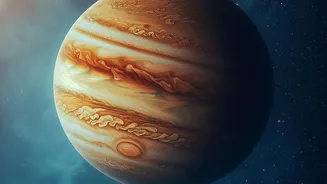
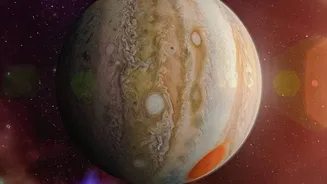
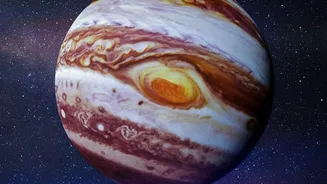
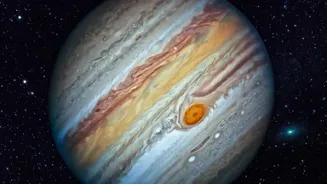
For as long as we have been able to gaze at Jupiter in detail, the Great Red Spot has been its defining feature. But recent observations show this iconic anticyclone is undergoing surprising transformations. For years, scientists have noted the storm
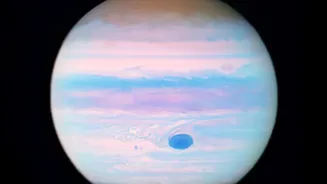
is shrinking. Once wide enough to swallow three Earths, it is now just about 1.3 times the width of our own planet. But the changes are more complex than simple shrinkage. New data reveals the storm is also changing its shape from a distinct oval to a more circular form. Most unexpectedly, recent images captured by the Hubble Space Telescope between late 2023 and early 2024 show the storm is oscillating, or jiggling, like a bowl of gelatin. This squeezing and stretching motion over a 90-day cycle was an unforeseen behaviour that currently has no clear hydrodynamic explanation.
More Than Just a Spot
The Great Red Spot is an immense high-pressure system in Jupiter’s southern hemisphere, a vortex with wind speeds far exceeding any hurricane on Earth, sometimes reaching over 650 kilometres per hour. It has been continuously monitored since at least 1830, making it a uniquely long-lived weather system to study. While its famous crimson colour has faded to a more orange hue over the years, the processes driving it remain a subject of intense scientific interest. The colour itself is thought to be the result of complex chemicals, perhaps phosphorus or sulfur compounds, being churned up from deep within Jupiter's atmosphere and reacting to sunlight. The storm's longevity and energy are a puzzle, but some theories suggest it is sustained by feeding on smaller, surrounding storms and eddies, which may also contribute to its changing dynamics.
The Science of a Changing Storm
Why is the Great Red Spot changing so dramatically now? The long-term shrinkage has been tracked for decades, with the rate of downsizing appearing to accelerate in the 2010s. The cause is not fully understood. One hypothesis is that smaller eddies are altering the storm's internal energy, either feeding it momentum or sapping it away. The newly discovered oscillation adds another layer to the mystery. As the storm wobbles, it seems to be pushing against the powerful jet streams to its north and south. This interaction could be influencing its shape and behaviour. While the storm is shrinking in width, some observations suggest it may also be growing taller, stretching further into Jupiter's upper atmosphere. The average wind speeds at its outer edge have also shown a slight increase in recent years, indicating that even as it shrinks, the storm is not necessarily weakening.
Our Eyes on Jupiter
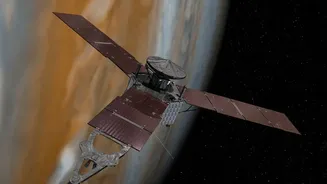
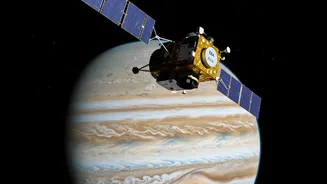
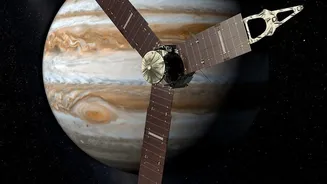
These incredible insights are thanks to a fleet of powerful observatories, both in space and on the ground. The Hubble Space Telescope, through its Outer Planet Atmospheres Legacy (OPAL) program, provides yearly global views of Jupiter, allowing scientists to track changes over time. These long-term observations are crucial for confirming trends like the storm's shrinkage. More recently, NASA's Juno spacecraft, which has been orbiting Jupiter since 2016, has provided the closest and most detailed images ever taken of the Great Red Spot. During its flybys, Juno passes just thousands of kilometres above the cloud tops, using its suite of scientific instruments to probe the storm's structure, composition, and deep roots. By combining data from these different missions, scientists can build a more complete picture of the forces reshaping this colossal weather system.