





An Unreachable World Beneath Our Feet
Earth’s core is a fascinating and mysterious place. Located more than 1,800 miles (or about 3,000 kilometers) beneath the surface, it consists of a solid inner ball of iron and nickel surrounded by a liquid outer shell. The temperatures are scorching,
reaching around 9,000 degrees Fahrenheit (5,000 Celsius), and the pressure is millions of times greater than at the surface. These extreme conditions mean we can't drill down and study it directly; our most advanced technology has only managed to penetrate about 7.5 miles (12 kilometers) into the crust. Everything we know about this crucial part of our planet, which generates Earth's protective magnetic field, has been learned indirectly through methods like studying seismic waves from earthquakes.
A Journey to a Metal World
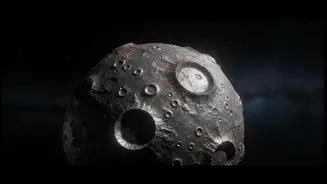
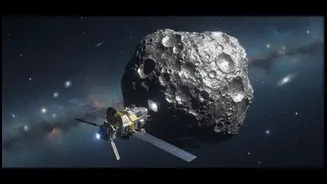
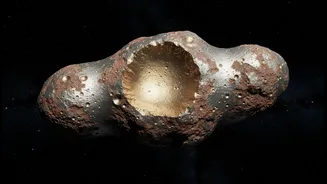
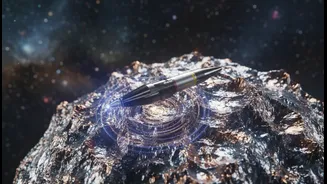
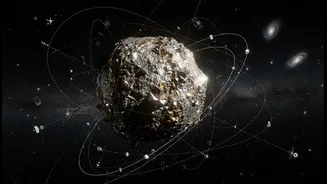
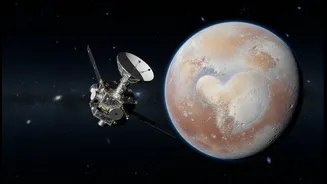
Enter NASA's Psyche mission. Launched in October 2023, this ambitious project is sending a spacecraft on a multi-year journey to a unique object in the main asteroid belt between Mars and Jupiter: an asteroid named 16 Psyche. This isn't just any space rock. Unlike most asteroids which are made of rock or ice, Psyche is believed to be extraordinarily rich in metal. Shaped like a potato and roughly the width of Massachusetts, it is the largest known metallic asteroid in our solar system. The spacecraft recently performed a crucial gravity-assist maneuver, using Mars's gravity in May 2026 to gain a 1,000-mile-per-hour speed boost and set its course for a 2029 arrival at the asteroid.
The Exposed Heart of a Failed Planet
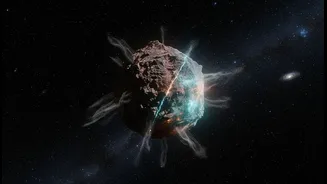
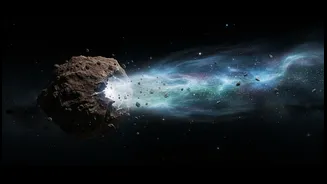
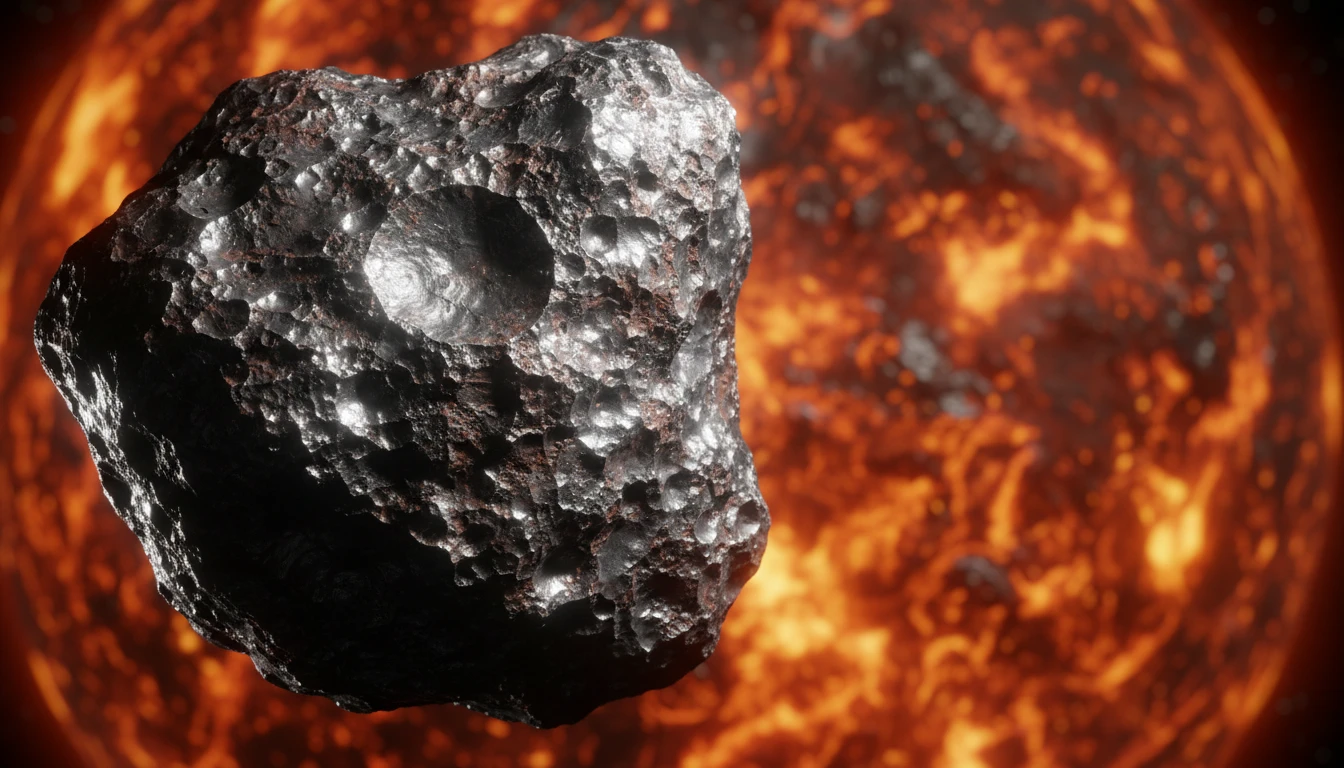
The leading theory, and the one that makes this mission so exciting, is that Psyche is the exposed iron-nickel core of a planetesimal—a building block of a planet from the early solar system. Billions of years ago, when the planets were forming, this planetesimal may have suffered one or more catastrophic collisions that stripped away its rocky outer layers, leaving only its dense, metallic heart behind. If this is true, visiting Psyche is the closest humanity can get to visiting a planetary core. It's a one-of-a-kind window into the violent processes that created terrestrial planets like Earth.
From Theory to Direct Observation
Studying Psyche gives scientists a chance to swap indirect inference for direct observation. Instead of relying solely on seismic data, they can analyze a real-world object that may be very similar in composition to our own core. When the spacecraft arrives, it will spend about two years orbiting Psyche, using a suite of instruments to map its surface, determine its precise composition, and search for signs of an ancient magnetic field. For example, scientists want to know if Psyche is a solid chunk of metal or more of a rubble pile. Early ground-based observations suggest it is likely a mixture of rock and metal, with a metal content between 30% and 60% by volume. The probe will also look for lighter elements that are hypothesized to exist in Earth's core. Answering these questions will test and refine the models we have for how all rocky planets form and evolve.
What Even a Surprise Result Will Teach Us
Even if Psyche turns out not to be a planetary core, the findings will be invaluable. The asteroid is a new type of world, unlike any we've visited before. Recent research has complicated the simple picture of Psyche as a pure iron body, suggesting it might be a more complex mix of metal and silicate rock. Some theories even propose the existence of "ferrovolcanism," where iron-spewing volcanoes coated a rocky body in metal. Whatever the spacecraft finds, it will add a crucial piece to the puzzle of our solar system's history. By journeying hundreds of millions of miles to an alien metal world, NASA is fundamentally deepening the understanding of the one we call home.