





India’s Next Interplanetary Frontier
Following the historic successes of the Chandrayaan missions to the Moon and the Mangalyaan mission to Mars, the Indian Space Research Organisation (ISRO) is setting its sights on our other planetary neighbour: Venus. The planned mission, named Shukrayaan-1
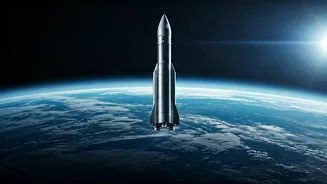
(from the Sanskrit words for Venus and craft), has received formal government approval and is slated for a launch in March 2028. This ambitious project marks India’s first dedicated mission to Venus and its next great leap in planetary exploration. The spacecraft, an orbiter laden with around 100 kilograms of scientific instruments, will be launched aboard India's heavy-lift LVM-3 rocket. After a journey of several months, it will settle into a highly elliptical orbit, beginning a multi-year study of the shrouded planet.
Why Venus? Earth’s Sinister Twin
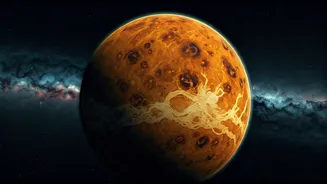
Venus and Earth are similar in size, mass, and composition, leading scientists to call them sister planets. However, their evolutionary paths diverged dramatically. While Earth became a haven for life, Venus devolved into the most inhospitable planet in the solar system. Its atmosphere is over 90 times denser than Earth's and consists of 96% carbon dioxide, creating a runaway greenhouse effect that pushes surface temperatures to a scorching 460°C. The planet is perpetually covered in thick clouds of sulphuric acid. Yet, scientists believe Venus may have once been much more like Earth, possibly hosting liquid water oceans billions of years ago. Understanding what caused this drastic climate shift is one of the most pressing questions in planetary science.
A Warning From Another World
The core purpose of the Shukrayaan-1 mission extends far beyond just studying another planet; it's about understanding our own. Venus serves as a natural laboratory for studying a greenhouse effect pushed to its absolute extreme. By investigating how Venus transformed from a potentially habitable world into a scorching wasteland, scientists can gain invaluable insights into planetary climate dynamics. These lessons are directly relevant to Earth. As our own planet grapples with rising carbon dioxide levels and climate change, the data from Venus can help refine our climate models, test our theories, and provide a stark warning of what can happen when a planet’s climate balance is irrevocably broken. In this sense, Shukrayaan isn't just an exploration; it’s a crucial data-gathering mission for safeguarding Earth's future.
The Scientific Toolkit for a Hostile Planet
To peel back the mysteries of Venus, Shukrayaan-1 will carry a sophisticated suite of instruments, developed both in India and through international collaborations with agencies from Sweden, Russia, and France. One of the key payloads is a high-resolution Synthetic Aperture Radar (SAR), which has the ability to pierce through the dense cloud cover and map the planet's surface in detail—something that has not been done with such precision before. The mission will also deploy a ground-penetrating radar, a world-first for Venus, to investigate the shallow subsurface. Other instruments will analyze the composition and circulation of the atmosphere, study the interaction between the planet's upper atmosphere and the solar wind, and investigate its volcanic activity.
A New Chapter in India's Space Odyssey
Shukrayaan-1 is a cornerstone of India's expanding ambitions in space, which include a human spaceflight program (Gaganyaan), further lunar exploration, and plans for an Indian space station by 2035. Exploring Venus presents immense technical challenges due to the planet's extreme heat, high pressure, and corrosive atmosphere. Successfully operating a complex spacecraft in such an environment will be a significant demonstration of ISRO's technological prowess. More than just a quest for knowledge, this mission is a statement of India’s growing capabilities as a major player in global space exploration, ready to tackle some of the solar system’s most challenging and scientifically rewarding destinations.