




First Clues: The Path Through Our Sky
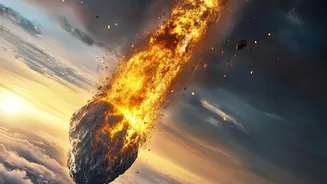
The investigation begins the moment a meteoroid enters Earth's atmosphere and becomes a meteor. Scientists gather data from multiple sources to reconstruct its fiery descent. Networks of all-sky cameras, often operated by both professionals and citizen
scientists, capture the meteor's path against the backdrop of stars. By combining footage from different locations, they can use a method called triangulation to plot the meteor's trajectory in three dimensions. This helps determine its speed, angle of entry, and the exact path it took through the atmosphere. Even eyewitness accounts and Doppler radar, which can detect the object as it falls, contribute to building this initial picture of the event.
Working Backwards: The Entry Point and Orbit
Once the atmospheric trajectory is established, the real physics-heavy work begins. Scientists use the principles of motion and gravity to work backwards. They take the calculated velocity and position just before the meteoroid started to burn up and enter this data into sophisticated computer models. These models account for factors like Earth's rotation and gravitational pull to essentially 'rewind' the object's path out of the atmosphere and back into space. This process allows them to calculate its original orbit around the Sun. A straight-line trajectory is a common assumption for the short journey through our atmosphere, but accurately plotting its pre-Earth orbit is key to finding its home.
A Cosmic Fingerprint: Analysing the Rock
If a piece of the meteor survives the journey and lands on Earth, it becomes a meteorite, and scientists get their most valuable piece of evidence. The meteorite's composition is like a cosmic DNA test. Most meteorites originate from the asteroid belt between Mars and Jupiter. Scientists can determine this by analysing the rock's chemical and mineral makeup. For instance, many stony meteorites contain chondrules—tiny, ancient spherical grains that formed in the early solar system and are not found in Earth rocks. Iron meteorites, made of an iron-nickel alloy, are believed to be the cores of ancient, shattered proto-planets. By studying the light reflected from the meteorite and comparing it to the light signatures of known asteroids, they can often find a direct match.
Isotopic Clues and Special Origins
To get even more specific, researchers perform isotopic analysis. Different bodies in the solar system have unique ratios of isotopes—variants of elements with different numbers of neutrons. By measuring the ratios of elements like oxygen in a meteorite, scientists can create a unique fingerprint. This is how we know some meteorites have come from the Moon or even Mars. For lunar meteorites, the composition perfectly matches the rock samples brought back by the Apollo missions. For Martian meteorites, gases trapped inside the rock have an isotopic composition that is an exact match for the atmosphere of Mars, as measured by probes like the Viking landers.