




The Science of Sound as a Wave
To understand why space is silent, we first need to understand what sound is. Sound is a mechanical wave, which means it needs a medium—a substance made of particles—to travel through. [1, 9] Think of it like ripples spreading across a pond after you
toss a stone in. The stone's impact creates a disturbance, and that energy travels through the water molecules. Sound works similarly. When an object vibrates, like a guitar string being plucked or our vocal cords speaking, it pushes against the particles of the medium around it (usually air). [14, 1] These particles then bump into their neighbors, which bump into theirs, creating a chain reaction of vibrations that our ears detect and our brains interpret as sound. [9] This process creates areas of compressed particles and areas where they are spread apart, known as compressions and rarefactions, which form the sound wave. [4]
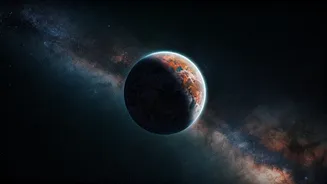
Space: An Almost Perfect Vacuum
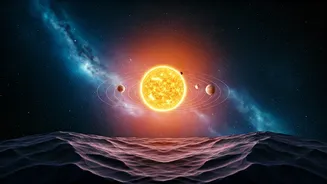
The reason sound can't travel in space is simple: there’s no medium for it to travel through. Space is what we call a vacuum, which by definition is a space devoid of matter. [5, 16] Now, it's not a 'perfect' vacuum. [6] Even in the vast emptiness between stars and galaxies, there are still some particles floating around, like a few hydrogen atoms per cubic meter. [8] But these particles are so incredibly spread out—far more so than in any vacuum we can create on Earth—that they can't effectively collide and transmit vibrations. [15] For a sound wave to propagate, particles need to be close enough to interact with each other. In the near-total emptiness of interstellar space, a vibrating object has nothing to push against, so the sound energy has nowhere to go. [19]
Why Sci-Fi Explosions Are Silent
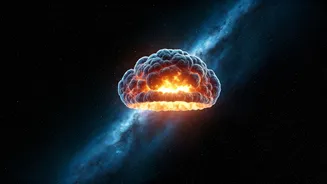
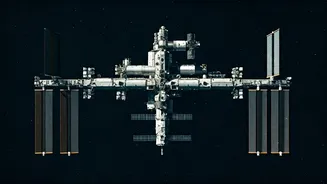
This brings us to one of the most common scientific inaccuracies in popular culture: the loud, booming explosions in science fiction movies. From Star Wars to Guardians of the Galaxy, we are used to seeing and hearing massive fireballs erupt in the vacuum of space. While visually spectacular, these scenes are scientifically misleading. In reality, the destruction of a spaceship would be a completely silent event for an outside observer. The energy would be released as light and heat, but without a medium like air, there would be no sound wave. [18] Filmmakers, of course, know this. They make a deliberate choice to add sound for dramatic effect and to meet audience expectations. The film 'Interstellar,' for example, was praised for its more realistic portrayal of space, often using silence during exterior shots to create a sense of isolation and vastness. [22]
But Are There Any Sounds in Space?
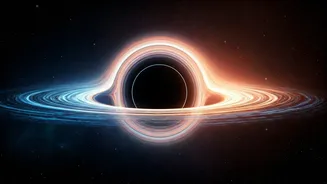
The rule that sound needs a medium holds true, but space isn't uniformly empty. There are places where sound waves can and do exist. For instance, galaxy clusters contain vast clouds of hot gas that can carry pressure waves. [10] In 2003, astronomers using NASA's Chandra X-ray Observatory detected pressure waves rippling through the gas in the Perseus galaxy cluster, sent out by a supermassive black hole. [10, 11] These waves are essentially sound waves, but their frequency is incredibly low—about 57 octaves below middle C, far too deep for any human to hear. [11] To make this cosmic 'sound' perceptible, scientists use a process called sonification, where they translate astronomical data into audible signals. [7] They convert data from different light wavelengths into notes we can hear, allowing us to experience phenomena like black holes in a new way. [13] So, while you can't hear a spaceship explode, in a way, the cosmos is filled with its own unique, inaudible music.