







A Shifting Seascape
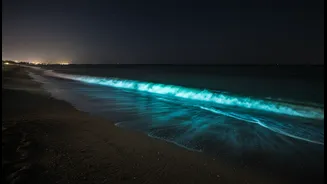
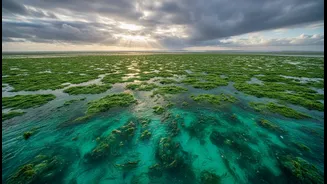
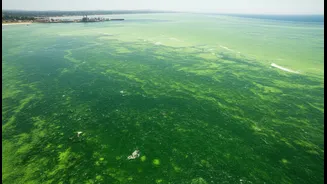
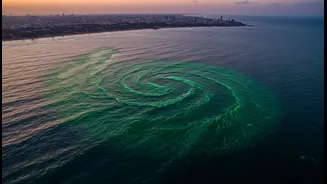
Along Mumbai’s coast, the Arabian Sea has been putting on a strange show. Waters that glow an eerie blue by night and turn a murky green by day have become an increasingly common sight. This phenomenon is caused by massive blooms of a specific type of plankton,
a dinoflagellate known as Noctiluca scintillans, or 'sea sparkle'. Traditionally, the Arabian Sea has two main bloom periods tied to the monsoons, one in summer and one in winter. However, the recent appearances of these Noctiluca blooms are happening outside this established seasonal calendar. These organisms are highly adaptable, acting like both a plant and an animal by photosynthesizing in the absence of prey. This resilience allows them to thrive in changing ocean conditions, which is why their unseasonal appearance is a significant red flag for scientists.
The Old Weather Playbook
For decades, weather forecasting in India, especially the all-important monsoon prediction, has relied on complex dynamical models. These models are essentially sophisticated computer simulations that use a vast amount of data — including sea surface temperature (SST), atmospheric pressure, wind patterns, and humidity — to predict future weather. The Arabian Sea plays a crucial role in these calculations. Historically, the temperature differences between the land and the sea, along with predictable ocean currents and nutrient cycles, have provided a reliable foundation for these models to forecast the timing and intensity of the monsoon rains that are vital for the entire subcontinent. These predictions, issued by agencies like the India Meteorological Department (IMD), are critical for everything from farming to urban planning and disaster management in a city as vulnerable as Mumbai.
The Plankton Curveball
The explosion of off-season Noctiluca blooms throws a wrench into these finely-tuned models. A dense bloom acts like a blanket on the ocean surface, altering its temperature. By absorbing more sunlight, these blooms can warm the surface layer of the water, which is a critical data point for weather models. This warming increases the stratification, or layering, of the ocean water, preventing cooler, nutrient-rich water from the deep from mixing with the surface. This disruption affects the land-sea temperature contrast, a key driver of monsoon winds. Weather models are built on historical patterns, and when a new, unpredictable variable like a massive biological event alters fundamental inputs like SST and ocean mixing, the models' accuracy can be significantly compromised. The timing and intensity of rainfall become harder to predict when the ocean's surface behaviour deviates from the norm.
A Climate Change Connection
Scientists largely agree that the root cause of these ecosystem shifts is climate change. Research has linked the proliferation of Noctiluca blooms to the rapid warming of the Arabian Sea. One major factor is the melting of glaciers in the Himalayan-Tibetan plateau. Less snow cover means the landmass heats up more, leading to warmer, moister winds blowing over the sea. These warmer winds reduce the process of convective mixing, where cold surface water sinks and brings nutrients up from the deep. Diatoms, the beneficial plankton that form the base of the marine food web, struggle in these nutrient-poor conditions. But Noctiluca, being a resilient mixotroph that can survive in low-oxygen water and feed on other organisms, thrives. Runoff from urban centres like Mumbai also pumps excess nutrients into the coastal waters, further fuelling these blooms.
Beyond the Forecast
The implications of this shift extend far beyond weather prediction. The dominance of Noctiluca is rewiring the entire marine food web. These organisms are not a good food source for most marine life; they outcompete and even consume the diatoms that support commercial fish stocks like sardines and mackerel. This has led to concerns about a severe impact on the fishing industry, which supports millions of people along India's west coast. Furthermore, as these blooms die and decay, they consume large amounts of oxygen, creating hypoxic 'dead zones' where fish cannot survive and releasing ammonia, which can be toxic to marine life. The slimy masses have also been known to clog the intake pipes of coastal infrastructure, including desalination plants that supply fresh water.