




The Coolest Science in Orbit
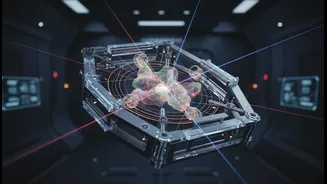
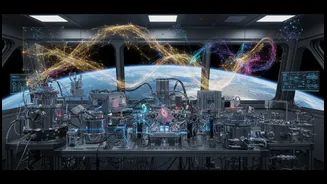
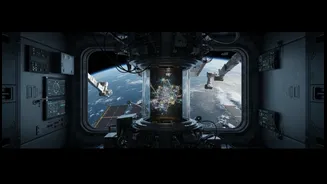
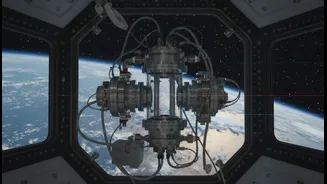
Imagine a science lab the size of a mini-fridge, but instead of keeping drinks cool, it chills atoms to temperatures a fraction of a degree above absolute zero—the coldest temperature matter can reach. That's the Cold Atom Laboratory (CAL), a quantum
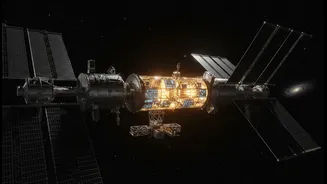
physics facility that has been operating on the International Space Station (ISS) since 2018. Its mission is to study a bizarre fifth state of matter known as a Bose-Einstein Condensate (BEC). To create a BEC, scientists use lasers and magnetic fields to slow down atoms of elements like rubidium until they are almost motionless. At this extreme cold, the atoms stop behaving like individual particles and merge into a single, massive quantum wave. This allows scientists to observe weird quantum effects, which are normally confined to the subatomic realm, on a macroscopic scale.
Why Space is the Ultimate Laboratory
Creating these ultracold atom clouds on Earth is incredibly challenging. Gravity is the main problem; the planet’s pull is a constant, disruptive force that yanks the delicate condensates apart in mere milliseconds, giving researchers only a fleeting glimpse. This is where the ISS provides a game-changing advantage. In the persistent free-fall of microgravity, these effects are almost completely removed. The atom clouds can float undisturbed, allowing them to exist for much longer—up to ten seconds or more. This extended observation time allows the atoms to get even colder and expand larger than is possible on Earth, giving scientists a clear, slow-motion view into the quantum world. The entire lab is operated remotely from NASA's Jet Propulsion Laboratory, with no astronaut assistance required for the experiments themselves.
What the New Upgrade Unlocks
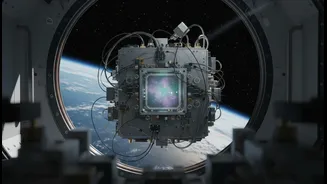
In 2026, astronauts installed the fourth major upgrade to the CAL since its launch. The new hardware, which arrived in April, includes a redesigned magnetic trap that gives scientists more control over the shape of the atom clouds, as well as improved atom sources and more advanced measurement tools. One of the key additions is a sophisticated atom interferometer, a quantum tool that can make incredibly precise measurements of forces like gravity. These enhancements mean researchers can now create BECs that are significantly larger and conduct a wider range of experiments, pushing the boundaries of what can be studied in orbit. This isn't just about incremental improvements; it’s about transforming the station into a premier facility for pioneering quantum research.
The Bigger Story: Probing the Universe's Secrets
So, what is the bigger story? It's twofold. First, the CAL is a tool for fundamental discovery. By studying how these quantum gases behave in space, scientists hope to tackle some of the biggest questions in physics. The experiments are designed to test Albert Einstein's equivalence principle—the idea that gravity affects all objects equally—with unprecedented precision. Furthermore, researchers believe this work could offer new insights into the nature of dark matter and dark energy, the mysterious phenomena that make up the vast majority of our universe. It’s about using this unique lab to find the cracks in our current understanding of reality.
From Quantum Science to Future Technology
The second part of the story is about building the future. The research aboard the ISS is a crucial stepping stone toward a new generation of quantum technologies, a field sometimes called 'Quantum 2.0'. The ultra-sensitive atom interferometers being tested could lead to incredible new tools. Imagine creating high-precision maps of Earth’s gravity to monitor water levels in underground aquifers or the melting of ice sheets. These technologies could also enable spacecraft to navigate deep space or on the Moon without relying on GPS. By demonstrating that this complex technology can work reliably in space, the CAL is laying the foundation for a future where quantum sensors, advanced timekeeping, and new computing capabilities are not just theoretical but operational.