






What Exactly Is Zone 2?
Think of Zone 2 as your “all-day” pace. It's a low-to-moderate exercise intensity, typically corresponding to 60-70% of your maximum heart rate. The easiest way to gauge it without a heart rate monitor is the 'talk test': you should be able to hold a full
conversation without gasping for breath. Your breathing is rhythmic and controlled, and the effort feels comfortably steady. This isn't a high-octane, sweat-dripping sprint; it's a sustained, purposeful effort that builds your aerobic foundation from the ground up. The goal is to spend a significant amount of time in this state, allowing your body to make specific, powerful adaptations that high-intensity training alone can't provide.
The Cellular Engine for Endurance
The magic of Zone 2 happens deep within your cells, specifically in the mitochondria. These are the tiny powerhouses that generate most of your body's energy. Consistent Zone 2 training stimulates the growth of new, more efficient mitochondria, a process known as mitochondrial biogenesis. This enhanced mitochondrial function improves your body's ability to use fat as its primary fuel source, sparing your limited carbohydrate stores for more intense efforts. It also makes you better at clearing lactate, the byproduct often associated with muscle burn. In Zone 2, your body clears lactate at the same rate it produces it, allowing you to sustain your effort for longer periods with less fatigue.
Why Rowing Is a Perfect Match
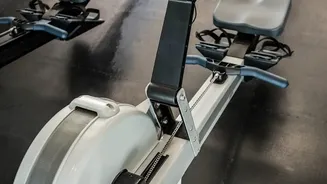
While you can perform Zone 2 training with many activities like running or cycling, rowing is an exceptional choice. As a full-body workout, rowing engages over 85% of your muscles, distributing the effort across your legs, core, and upper body. This holistic engagement allows you to keep your heart rate in the desired zone for extended periods without overloading any single muscle group. Furthermore, rowing is a low-impact activity. Unlike the repetitive pounding of running, rowing is gentle on your joints, significantly reducing the risk of stress-related injuries and making it a sustainable practice for people of all fitness levels.
How to Find Your Zone 2 on the Rower
To start, focus on maintaining a consistent, conversational pace. A good target for stroke rate (SPM) is typically between 18 and 22. The key isn't speed, but steady, continuous effort. If you're using a heart rate monitor, the most common method is to calculate 60-70% of your maximum heart rate. A simple estimation for your max heart rate is 220 minus your age. For example, a 40-year-old would have an estimated max heart rate of 180, putting their Zone 2 range between 108 and 126 beats per minute. Remember, this is a guideline; listen to your body. If you can't speak comfortably, you're likely pushing too hard.
Avoiding the Overtraining Trap
One of the most significant benefits of Zone 2 training is its role in preventing overtraining. High-intensity workouts are highly stressful on the body and nervous system, requiring significant recovery time. Trying to go hard every day often leads to fatigue, diminished performance, and injury. Because Zone 2 is a lower-stress activity, it allows you to accumulate significant training volume without overwhelming your system. It builds your aerobic base and improves recovery, enabling you to get more out of your harder workout days. A polarized training model, where roughly 80% of your training is low-intensity (Zone 2) and 20% is high-intensity, is a proven strategy used by elite athletes to maximize fitness while minimizing burnout.