



The Invisible Threat of Space
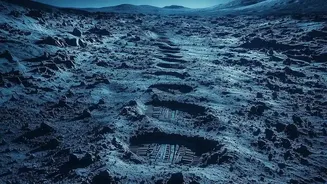
Earth’s magnetic field and thick atmosphere act as a planetary shield, deflecting the vast majority of harmful space radiation. Astronauts on the Moon have no such luxury. They face two primary radiation threats: galactic cosmic rays (GCRs) and solar
particle events (SPEs). GCRs are high-energy particles from distant supernovae, a constant, penetrating shower that can damage DNA and increase long-term health risks like cancer and degenerative diseases. SPEs, which are unpredictable bursts of radiation from solar flares, are more acute and can cause radiation sickness in unprotected astronauts. Building habitats on the surface that can block this radiation would require transporting massive amounts of heavy shielding from Earth or piling up several meters of lunar soil, a costly and complex undertaking.
Nature's Unexpected Shelter
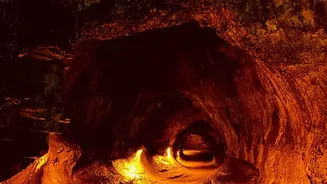
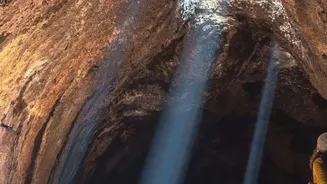
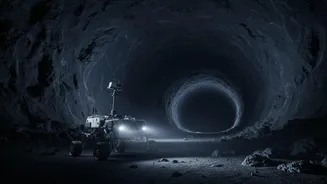
The solution may have been waiting for us all along, hidden just beneath the Moon's surface. Billions of years ago, when the Moon was volcanically active, rivers of molten rock flowed across its plains. The top layer of these flows cooled and solidified, while the hot lava underneath continued to move, eventually draining away to leave behind vast, hollow tunnels known as lava tubes. For decades, these were theoretical, but recent data from orbiters has provided strong evidence of their existence, identifying pits or 'skylights' where a section of a tube's roof has collapsed, revealing a gateway to the caverns below. Some of these tubes are potentially enormous—wide enough to house entire cities and stretching for kilometers.
A Shield Made of Solid Rock
The genius of using lava tubes lies in their simplicity. The thick ceiling of solid basaltic rock and overlying regolith provides a natural, ready-made shield against radiation. A roof of just a few meters is believed to be enough to dramatically reduce exposure to both GCRs and SPEs, bringing radiation levels inside the tube down to something comparable to, or even safer than, what we experience on Earth. Instead of the 100-400 millisieverts of radiation per year on the surface, the dose inside a lava tube could drop to as low as 1-20 millisieverts. This massive layer of rock simply absorbs the energy of incoming particles, providing complete protection without the need to build and bury a habitat.
More Than Just a Roof
Beyond radiation shielding, lava tubes solve several other critical problems for lunar settlers. The Moon's surface experiences wild temperature swings, from a scorching 120°C in sunlight to a frigid -170°C in darkness. Inside a lava tube, however, the temperature is remarkably stable, hovering around a constant -20°C. While cold, this stable environment is far easier for life support systems to manage than the extreme surface fluctuations. These subterranean caverns also offer automatic protection from another constant threat: micrometeoroid impacts. Even tiny space debris can cause catastrophic damage to surface structures, a danger that is completely negated underground.
The Challenge of Moving In
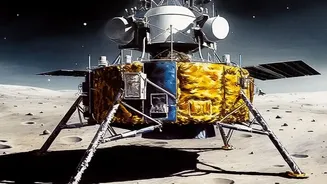
Of course, transforming these primordial caves into human habitats is not a simple task. First, robotic missions must thoroughly map these tubes to confirm their size, stability, and accessibility. Actually getting people and equipment inside through a skylight would require complex robotic and crane systems. Once inside, inflatable habitats could be deployed and sealed within the tube's protective shell. Power would likely need to come from solar arrays on the surface, connected by cables, and communication systems would have to be established to link the subterranean base with Earth. There are also risks of ceiling collapses from seismic activity to consider. However, these engineering challenges are seen as far more surmountable than the fundamental problem of shielding a base on the exposed lunar surface.