


Venus, The Dazzling Evening Star
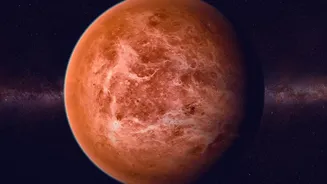
You simply cannot miss Venus this month. Look to the western horizon right after sunset, and you will spot a brilliant, unwavering point of light that outshines everything else. Venus reached its greatest evening elongation, or farthest point from the sun in our
sky, around mid-August. This means it remains visible for longer after sunset, dominating the twilight sky. You don't need any special equipment; its brightness makes it an easy and rewarding target for all. As the month progresses, watch as it appears to get closer to the bright star Spica in the constellation Virgo.
Saturn Rises in the East
As darkness falls, turn your attention to the eastern sky to spot Saturn. While its highly anticipated opposition, when it will be at its biggest and brightest for the year, is on October 4, the planet is already a fantastic object for evening viewing throughout late August. It rises in the east around sunset and will be visible all night long. To the naked eye, it appears as a steady, golden-hued point of light. Even a basic pair of binoculars might give you a hint of its unique shape, but a small telescope will begin to reveal its magnificent rings, which are currently tilted at a fascinating, narrow angle from our perspective.
The Summer Triangle Overhead
High above in the night sky lies one of the most recognizable patterns of the season: the Summer Triangle. This is not a constellation but an asterism, a simple shape formed by three of the brightest stars in the sky. It is comprised of Vega in the constellation Lyra, Deneb in Cygnus (the Swan), and Altair in Aquila (the Eagle). These three bright stars form a large, distinct triangle that is easy to spot even with some light pollution, making it a perfect landmark for navigating the summer sky. Vega is the brightest of the three and one of the brightest stars in the entire night sky.
Scorpius and the Milky Way's Heart
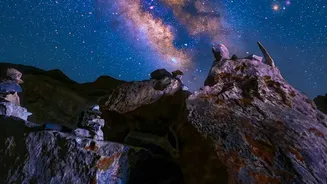
Look towards the southern sky to find the distinct, J-shaped constellation of Scorpius the Scorpion. Its brightest star, Antares, is a reddish supergiant often called the "heart of the scorpion." August provides a great view of this constellation before it starts setting earlier in the evening. In this same direction, you are looking towards the heart of our own Milky Way galaxy. If you can get away from city lights to a truly dark location, you will see this area glowing with the faint, hazy band of countless distant stars, a truly awe-inspiring sight.
Catching the Last of the Perseids
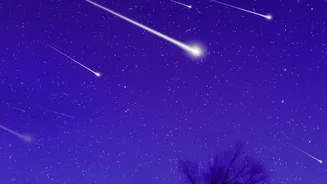
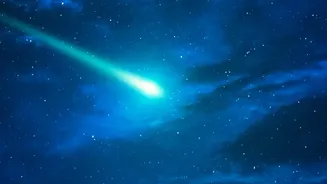
The famous Perseid meteor shower had its spectacular peak around August 12-13, offering one of the best shows in years thanks to a new moon that kept skies dark. While the peak has passed, the shower remains active until late August. This means you still have a chance to spot a few lingering "shooting stars" in the late hours of the night. For the best chance, find a dark spot away from city lights, let your eyes adjust for at least 15-20 minutes, and look towards the northeast. While you won't see the peak rate of nearly 100 meteors per hour, catching a stray, bright Perseid streak across the sky is still a magical experience.
A Glimpse of a Partial Lunar Eclipse
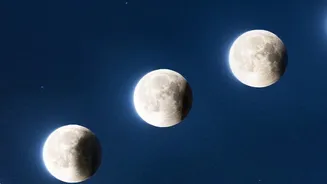
Mark your calendars for the very end of the month. On the night of August 27-28, a partial lunar eclipse will occur. During this event, a portion of the full moon will pass through the Earth's dark inner shadow, the umbra, making it look as though a piece of the moon has been darkened or bitten out. While the most dramatic phases of this eclipse will be best viewed from the Americas, Europe, and Africa, it serves as a reminder of the constant celestial dance happening above us. Unlike a solar eclipse, a lunar eclipse is perfectly safe to view with your naked eyes.