

A Crisis in the Cold Desert
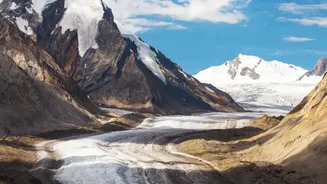
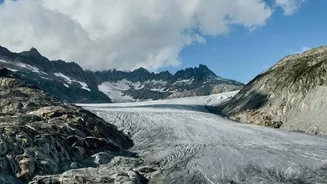
Ladakh, a region nestled in the Himalayas, is a land of stark beauty defined by its arid, mountainous terrain. With annual rainfall often less than 100mm, communities have for centuries depended on a single, vital source of water: the seasonal melting
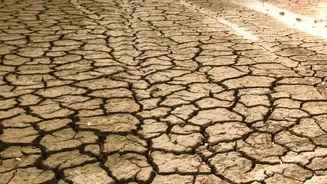
of glaciers. But climate change is rapidly disrupting this ancient rhythm. Glaciers are retreating, and winter snowfall has become less predictable. This leads to a critical paradox: flash floods from premature melting in winter, followed by severe water scarcity in the crucial spring planting months when farmers need it most. This disruption threatens not only agriculture but the very foundation of life and food security in the region.
An Engineer's Icy Inspiration
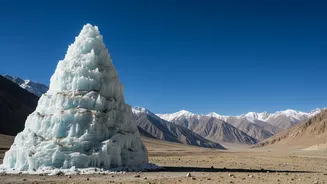
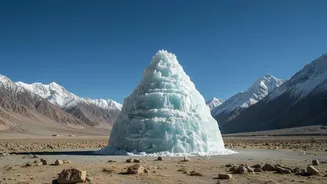
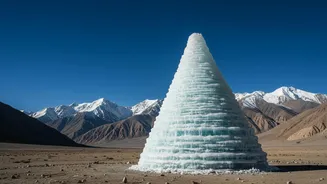
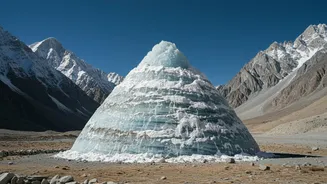
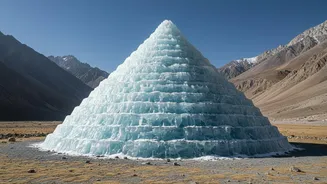
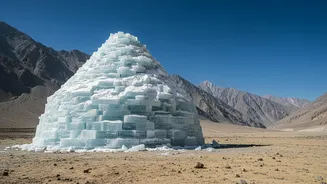
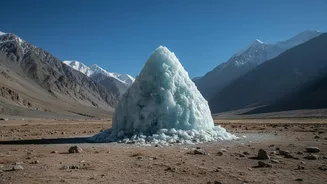
The solution came from local engineer, innovator, and educator Sonam Wangchuk. The idea was sparked by a simple observation: in late spring, he noticed a patch of ice still intact under a bridge, shielded from the direct sun, long after other ice had melted. Wangchuk realised that the shape of an ice mass was key to its longevity. While horizontal ice fields melted quickly due to their large surface area, a vertical, conical shape would minimise exposure to the sun and last longer into the warmer months. This led to the concept of the 'ice stupa', named for its resemblance to traditional Buddhist monuments that are sacred in Ladakh. The name helped connect the modern technology with local culture, fostering community acceptance and engagement.
How to Build a Glacier
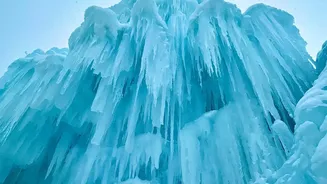
The engineering behind the ice stupa is remarkably simple and elegant, relying on gravity and basic principles of physics. A pipeline channels frigid water from a glacial stream at a higher altitude down to a village. At the chosen site, the pipe is angled upwards, and the water, under natural pressure, sprays out from a sprinkler into the sub-zero winter air. The water freezes almost instantly as it falls, gradually forming a massive, cone-shaped mound of ice. The first prototype, built in 2014, stood six metres tall and stored 150,000 litres of water, lasting well into mid-May. This stored water becomes available for irrigation precisely when farmers need it, bridging the gap left by retreating natural glaciers.
A Revolution of Empowerment
The ice stupa is more than just a water storage technique; it's a community-led movement. The project, driven by Wangchuk's NGO, SECMOL, and later the Himalayan Institute of Alternatives, Ladakh (HIAL), has empowered local villagers. Competitions are held to see which village can build the tallest stupa, fostering a sense of ownership and friendly rivalry. The results have been transformative. The meltwater from these artificial glaciers has irrigated thousands of newly planted trees and revived agriculture in villages that were facing desertification. This grassroots success has helped to revive 'ghost villages' abandoned due to water shortages and has even spurred eco-tourism and winter sports initiatives, creating new livelihood opportunities.
From Ladakh to the World
The success of the ice stupa has resonated far beyond the Himalayas. Its low-cost, gravity-powered design makes it a powerful model for other mountainous regions grappling with similar water crises. The concept is now being adapted and tested globally. Inspired by the work in Ladakh, projects have been initiated in other parts of the Himalayas, including in Nepal and Pakistan. In Europe, Switzerland has built its own experimental ice stupas to test their effectiveness in the Alps. Further afield, a group of engineers in Chile, facing drought and shrinking glaciers in the Andes, have started a pilot project modelled directly on the Ladakhi stupas. This South-to-South knowledge transfer highlights the universal appeal of a solution that is simple, scalable, and deeply connected to its environment.