





Beyond Sunshine and Rain
When we think of weather, we usually imagine rain, wind, and temperature. But there's another kind of weather, one that originates 150 million kilometres away, that has a growing impact on our world. Space weather refers to the changing conditions in space,
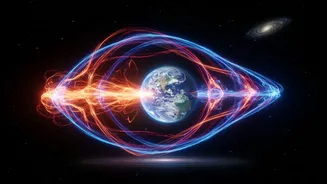
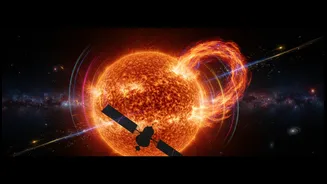
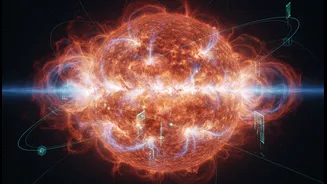
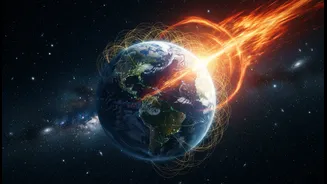
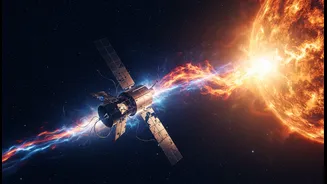
driven primarily by the Sun. Our star is not a calm, steady ball of light; it's a dynamic entity that frequently releases massive bursts of energy and particles. These events, known as solar flares and Coronal Mass Ejections (CMEs), send streams of charged particles hurtling through space. When these streams hit Earth, they interact with our planet's magnetic field and atmosphere, creating what we call space weather.
A Threat to Our Modern World
In an increasingly digital India, our dependence on space-based technology is absolute. From the GPS that guides our cabs and the satellites that beam our television shows, to the complex networks that manage our power grids and banking systems, we are vulnerable to solar tantrums. A severe space weather event could damage satellites, disrupt communication and navigation systems, and even cause widespread power outages on the ground. This makes predicting these events not just a scientific curiosity, but a matter of national security and economic stability. As India expands its space infrastructure, including the Gaganyaan human spaceflight program, the need for accurate space weather forecasting becomes even more urgent to protect our astronauts and assets.
India’s Eyes on the Sun
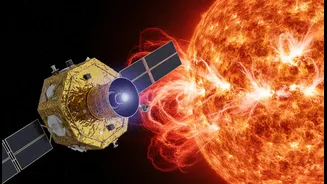
Recognising this critical need, India has significantly ramped up its efforts in solar physics and space weather monitoring. The crown jewel of this endeavour is the Indian Space Research Organisation's (ISRO) Aditya-L1 mission. Launched in 2023, this space observatory is positioned at a unique vantage point 1.5 million kilometres from Earth, allowing it to continuously watch the Sun without interruption. Aditya-L1 is equipped with a suite of instruments designed to study solar activity and provide early warnings of potentially disruptive events. The data from this mission, along with a network of ground-based observatories, is foundational to developing India's own state-of-the-art prediction models. Just recently, scientists from the Indian Institute of Geomagnetism developed a new technique to map Earth's upper atmosphere with greater accuracy, a breakthrough that will significantly improve regional space weather predictions.
The New Skill Lane: What to Study
This national push is creating a new and exciting career path for students. To become a space weather forecaster or researcher, a strong foundation in science is key. Students in school should focus on Physics and Mathematics. At the university level, a degree in Physics, Astrophysics, or Geophysics is an excellent starting point. Several Indian institutions are at the forefront of this field. The Indian Institute of Geomagnetism (IIG), the Indian Institute of Astrophysics (IIA), the Physical Research Laboratory (PRL), and various IITs and IISERs offer relevant programs and research opportunities. To foster talent, ISRO and IIG have even started a joint Space Weather Summer School for Master's students, providing hands-on training with real data.
Careers Among the Stars (and on Earth)
A qualification in space weather opens doors to a variety of roles. Graduates can work as scientists and forecasters in national agencies like ISRO, IIG, and the National Atmospheric Research Laboratory. There are also opportunities in academia, contributing to research and teaching the next generation. As the private space sector in India grows, companies involved in building and operating satellites will need their own space weather experts to protect their investments. Furthermore, industries like aviation, shipping, and power grid management are becoming increasingly aware of their vulnerability to solar events, creating a demand for consultants and specialists who can help them mitigate risks. The field demands a mix of skills, including data analysis, numerical modelling, and even AI and machine learning to sift through vast amounts of solar data.