


The Cosmic Data Deluge
Modern astronomy is facing a monumental challenge that is also a phenomenal opportunity: a torrent of data. Telescopes like the Vera C. Rubin Observatory in Chile are set to capture an unprecedented volume of information, generating roughly 20 terabytes
every single night. This decade-long project will create a timelapse movie of the entire southern sky, producing a dataset so large—around 15 petabytes for the main catalogue alone—that no team of humans could ever hope to analyse it manually. This is where artificial intelligence moves from a theoretical novelty to an absolute necessity. The sheer size and complexity of these new datasets require automated approaches for analysis, classification, and ultimately, discovery. Without AI, many of the universe's most subtle secrets would remain buried in the noise.
Training Machines to Find New Worlds
One of the most exciting frontiers in astronomy is the search for exoplanets—planets orbiting distant stars. This hunt often involves staring at a star's light curve, looking for the tell-tale tiny dip in brightness that occurs when a planet passes in front of it. It’s a tedious task prone to human error, but it's perfect for a machine. AI models like NASA's ExoMiner are trained on vast archives of data from missions like Kepler and TESS, learning to distinguish the signature of a real planet from instrument noise or other cosmic phenomena. These AI tools can process thousands of stars at once, a task that would take a human researcher an impossibly long time. The results are staggering, with AI systems having already helped confirm hundreds of new exoplanets, including rare and extreme worlds that were initially missed by human analysis.
Catching Fleeting Cosmic Moments
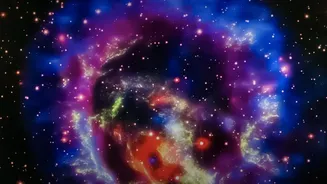
Some of the most significant events in the universe, like the explosive death of a star in a supernova, are incredibly brief. Spotting these transient events as they happen is crucial for follow-up observations, but they can appear and fade before anyone notices. AI is changing the game. Automated systems now scan the sky in real-time, searching for new sources of light that weren't there in previous images. In a world-first, a fully automated system named the Bright Transient Survey Bot (BTSbot) recently detected, identified, and confirmed a supernova without any human intervention. It sifted through data, flagged a candidate, and automatically triggered another robotic telescope to collect the spectrum needed for confirmation. This process, which used to take hours of manual work by astronomers, now happens almost instantly, freeing up valuable time for scientists to analyze the discoveries rather than make them.
A New Human-AI Partnership
The rise of AI in astronomy doesn't mean human astronomers are becoming obsolete. Instead, it signals a fundamental shift in their role. AI is becoming an indispensable partner, a 'copilot' for discovery that handles the immense task of data processing and pattern recognition. This allows scientists to move beyond rote classification and focus on bigger, more creative questions. AI can flag anomalies that don't fit any known category, presenting researchers with genuine mysteries to solve. It accelerates research projects that once took years into a matter of days. By automating technical tasks like scheduling telescope observations, AI gives astronomers more time to develop new hypotheses and interpret the fascinating phenomena the machines uncover. The future of astronomical discovery lies in this powerful human-computer collaboration.