


The Enemy of Sharpness: Earth's Unceasing Spin
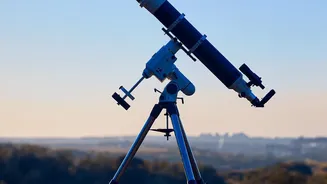
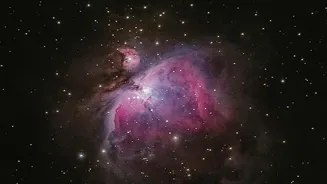
To capture the faint light from deep-sky objects millions of light-years away, photographers need to collect light for very long periods, often for many minutes or even hours. While a good-quality motorized telescope mount can track celestial objects to counteract
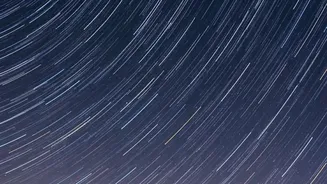
Earth's rotation, they are never perfect. Even with a flawless polar alignment, tiny imperfections in the mount's gears and bearings cause minuscule tracking errors. Over a long exposure, these errors cause stars to drift, transforming them from sharp pinpoints into blurry streaks or ovals. This issue, known as star trailing, is the primary hurdle between a blurry snapshot and a crystal-clear cosmic portrait.
The Solution: A Digital Co-Pilot for Your Telescope
This is where auto-guiding comes in. Think of it as a hyper-vigilant digital co-pilot for your telescope. An auto-guiding system is a closed-loop feedback mechanism that monitors a star and tells your telescope mount to make tiny, real-time corrections. Its sole job is to watch for any drift, no matter how small, and instantly nudge the mount back into perfect alignment. This continuous correction process is what allows astrophotographers to take exposures lasting several minutes or more, a necessity for revealing the faint, colorful details of nebulae and galaxies. Without it, photographers are often limited to exposures of just one or two minutes before star trailing ruins the shot.
Anatomy of an Auto-Guiding System
A typical auto-guiding setup consists of three key components working in harmony. First is a smaller, secondary telescope called a 'guide scope', which rides on top of the main telescope. Second is a 'guide camera'—a small, highly sensitive camera attached to the guide scope. This camera's job isn't to take the pretty picture, but to stare intently at a single, relatively bright 'guide star' in the field of view. The third component is the brains of the operation: a computer or a dedicated controller running guiding software, like the popular freeware PHD2. Together, these parts form a dedicated surveillance system for your telescope's tracking.
Chasing a Single Star to Perfection
The process is elegant in its simplicity. The guide camera takes rapid, short exposures of the guide star, sometimes several times per second. The software analyzes each image to measure the star's precise position down to a fraction of a pixel. If the software detects that the star has drifted from its original spot—even by an infinitesimal amount—it immediately sends a correction command to the telescope mount. This command, often sent through a standard ST-4 cable or a direct computer link, tells the mount's motors to nudge the telescope just enough to move the guide star back to its starting position. This cycle of 'measure, detect drift, correct' happens continuously throughout the entire imaging session.
Correcting More Than Just Rotation
While countering Earth's rotation is the main goal, auto-guiding also fixes other persistent mechanical issues. The most significant is 'periodic error', a predictable error caused by microscopic imperfections in the mount's worm gear that causes its tracking speed to slightly speed up and slow down over a cycle of a few minutes. Auto-guiding actively cancels out this error in real time. It also compensates for other unpredictable problems like wind gusts, minor vibrations, or flexure in the telescope's structure. Even mounts with built-in Periodic Error Correction (PEC) benefit from guiding, as it provides a live, dynamic solution to all sources of drift.