





What's In a Name?
First, let's break down the name. '3I/ATLAS' tells a story. The "3I" signifies that it is the third interstellar object ever confirmed by astronomers. The first was the mysterious, cigar-shaped 'Oumuamua in 2017, and the second was Comet 2I/Borisov in 2019.
The 'I' stands for interstellar, confirming its origin from outside our solar family. 'ATLAS' refers to the system that discovered it: the Asteroid Terrestrial-impact Last Alert System. This NASA-funded project in Chile is designed to spot potentially hazardous near-Earth objects, but its constant scanning of the sky also makes it perfect for catching unexpected guests like this one.
A Visitor from Far, Far Away
What does it mean for an object to be interstellar? Nearly every comet or asteroid we've ever seen originated right here, in our own solar system. They are leftovers from our sun's formation, orbiting in predictable paths. But 3I/ATLAS is a true outsider. Astronomers confirmed this by calculating its trajectory, which was found to be hyperbolic. This means it was moving too fast to be trapped by our sun's gravity. Instead of looping around the sun in a closed orbit, it swung by on a one-time journey, destined to return to the vastness of interstellar space. It came from the direction of the constellation Sagittarius, having traveled an unimaginable distance from a completely different star system.
What Makes This Comet So Special?
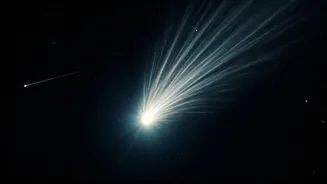
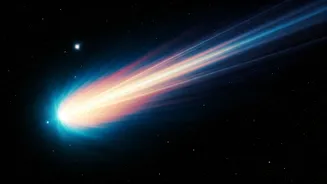
Being only the third of its kind makes 3I/ATLAS incredibly rare. But its scientific value goes much deeper. Interstellar objects are like probes sent from other star systems, carrying clues about how planets and comets form elsewhere in the galaxy. By studying the light and chemical makeup of 3I/ATLAS, scientists can learn about the building blocks of worlds far beyond our own. As the comet neared our sun, it heated up, releasing gases and dust from its nucleus. This created a 'coma', or atmosphere, that telescopes like the Hubble Space Telescope and James Webb Space Telescope could analyse.
A Glimpse into an Ancient Past
Observations from the James Webb Space Telescope revealed a surprising chemical composition. The comet contained a higher ratio of 'heavy hydrogen' (deuterium) and a different carbon signature compared to comets from our solar system. This suggests 3I/ATLAS formed in a very different, likely much colder, environment than our own system's comets. Its high speed also hints that it might have been ejected from the Milky Way's 'thick disk,' a population of old stars. This has led some scientists to believe that 3I/ATLAS could be ancient, possibly as old as 11 billion years—older than our own solar system. If true, it would be a time capsule from the early history of our galaxy.
The Journey Through Our System
Despite its cosmic significance, 3I/ATLAS was never a threat to Earth. It made its closest approach to the sun on October 29, 2025, passing at a distance just inside the orbit of Mars. Its closest pass of Earth was on December 19, 2025, when it was still a very safe 270 million kilometers away. While it was here, observatories on the ground and in space, including missions near Mars and Jupiter, turned their gaze toward it to gather as much data as possible before it sped away. This global effort provided an unprecedented look at a visitor that is already on its way back into the interstellar void, never to return.