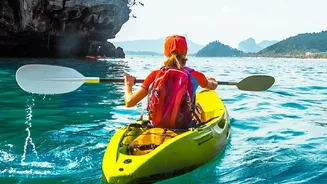






Tired of the gym? There’s a workout that feels more like an escape. Stand-up paddleboarding (SUP) combines a full-body challenge with the calm of being on the water, offering a unique blend of fitness and scenic relaxation.
More Than a Core Workout
While paddleboarding is famous
for building core strength, its benefits reach much further. Balancing on an unstable surface forces your abdominal and oblique muscles into constant action. But the real work comes from the paddle stroke, which engages your back, shoulders, and arms. Your lats (latissimus dorsi) are the primary drivers, pulling the paddle through the water, while your shoulders and arms control the movement. At the same time, your legs are in a perpetual state of engagement. Your quads, hamstrings, and glutes work continuously to maintain an athletic stance, absorb movement from the water, and stabilize your entire body. This turns every session into a genuine full-body workout, toning muscles you might not typically target in a gym setting.
A Heart-Healthy Glide
Paddleboarding is an excellent form of cardiovascular exercise that often doesn't feel like one. The continuous motion of paddling elevates your heart rate, providing a sustained aerobic workout similar to jogging or cycling but without the monotony. Even a casual paddle keeps your heart rate in a beneficial training zone, improving endurance and overall heart health over time. You can easily adjust the intensity; a leisurely glide offers a steady, moderate workout, while paddling against wind or at a faster pace can provide a high-intensity interval session. This scalability makes it suitable for various fitness levels, from beginners to seasoned athletes, all while you're enjoying the scenery.
Gentle on Your Joints
For those seeking an effective workout without the strain, paddleboarding's low-impact nature is a major draw. Unlike running or other high-impact activities that can be harsh on knees, hips, and ankles, SUP is gentle on your joints. The water absorbs much of the impact, allowing for a robust workout with a significantly lower risk of strain or injury. This makes it an ideal and sustainable form of exercise for people of all ages, including those recovering from injuries or dealing with joint sensitivity. The constant micro-adjustments your muscles make to maintain balance also help strengthen the small stabilizer muscles around your joints, improving overall stability.
The Scenic Fitness Advantage
Beyond the physical benefits, paddleboarding offers a significant boost for mental well being. Being on the water, surrounded by nature, has a naturally calming effect that can reduce stress and clear your mind. The rhythmic, gliding motion of paddling can be meditative, offering a peaceful escape from daily pressures. This combination of physical activity and a serene environment makes the workout feel less like a chore and more like a recreational outing. The simple act of exploring a coastline, lake, or river from a new perspective provides a sense of adventure and connection with nature that you can't find in a fitness studio.
Your First Time on the Water
Getting started with paddleboarding is easier than you might think. For your first outing, choose a calm body of water like a lake or a sheltered bay, and pick a day with little to no wind. Renting gear is a great way to try it without commitment. You’ll need a board, a paddle, and a leash, which keeps the board from floating away if you fall. Start by kneeling in the center of the board to get a feel for the balance. Once you're comfortable, you can slowly stand up, keeping your feet hip-width apart, knees slightly bent, and your gaze fixed on the horizon, not your feet. Remember to use your core to paddle, twisting your torso with each stroke rather than relying only on your arms.
Where to Paddle in India
India, with its vast coastline, serene backwaters, and numerous lakes, offers incredible opportunities for paddleboarding. The relatively calm waters of the backwaters in Kerala and Goa are perfect for beginners and those seeking a peaceful glide through lush scenery. Coastal areas like Rameswaram and the Palk Bay in Tamil Nadu offer flatwater conditions ideal for longdistance paddling. For those near urban centres, lakes around cities like Udaipur, or even some of the cleaner lakes near the NCR like the ones in the Asola Wildlife Sanctuary, are becoming hubs for the sport. A growing number of accredited schools and rental shops are making the sport more accessible than it used to be.