




What is the Kuiper Belt?
The Kuiper Belt is a vast, doughnut-shaped ring of icy bodies orbiting the Sun beyond Neptune. Think of it as a cosmic deep freeze, holding remnants from the formation of our solar system more than 4.5 billion years ago. This distant region is populated
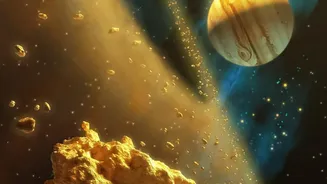
by millions of frozen objects, including dwarf planets like Pluto and Arrokoth. Occasional collisions between these icy bodies produce a fine dust that slowly drifts through space. While scientists have long theorized about the composition of this dust, getting actual samples has been a monumental challenge.
Cosmic Fishing in Earth's Stratosphere
How do you catch dust from the edge of the solar system? You let it come to you. A small fraction of the dust produced in the Kuiper Belt embarks on a long journey inward, pulled by solar radiation and the solar wind. Though the giant planets like Jupiter and Saturn eject most of it from the solar system, some particles make it all the way to Earth. To collect these precious samples before they are contaminated by terrestrial dust, NASA uses high-altitude research aircraft, flying through the pristine stratosphere some 60,000 feet up. These planes use special collectors, often coated in silicone oil, to gently capture the tiny interplanetary dust particles (IDPs).
What's Special About These Twelve Grains?
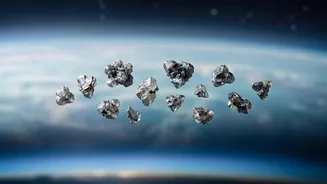
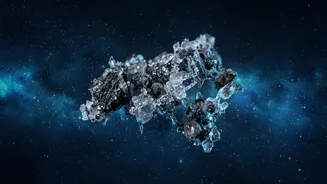
A recent analysis of twelve specific dust particles, published in November 2026, has yielded remarkable findings. Scientists were able to confirm their origin from the Kuiper Belt by studying the microscopic scars left on them by solar energetic particles. These particles had a much higher density of these 'track' marks, indicating a very long exposure time as they journeyed from the outer solar system. This long journey rules out a closer origin, like the asteroid belt between Mars and Jupiter. The analysis provided the first direct samples of material from a Kuiper Belt object.
A Primordial Heavy Water Reservoir
The most significant discovery came from what the dust was made of. The grains were found to contain hydrated minerals, which means they formed through a reaction between rock and liquid water at low temperatures. This finding provides direct evidence that liquid water once existed within icy bodies in the Kuiper Belt. Furthermore, analysis of the minerals' isotopes revealed that the water involved was enriched in 'heavy' oxygen, a stable, non-radioactive form of the element. This confirms a long-held but difficult-to-prove theory that a vast reservoir of heavy-oxygen water exists in the outer solar system, largely isolated from the water found in the inner solar system.
Why This Discovery Matters
These twelve tiny grains are rewriting our understanding of the solar system's architecture and history. They provide a physical sample that helps confirm what spacecraft like New Horizons have been observing from afar. The evidence of a separate water reservoir, kept apart by the gravity of giant planets like Saturn, offers crucial clues about how our planetary system formed and evolved. By studying these building blocks, scientists can better piece together the initial inventory of materials—including water and organic compounds—that were available for planet formation. Essentially, these particles are time capsules, offering a glimpse into the chemical makeup of the nebula from which our Sun and planets were born.