




Two New Eyes on Our Star
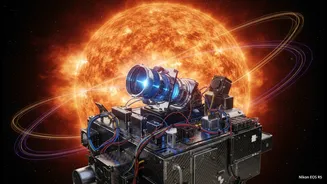
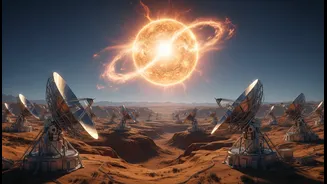
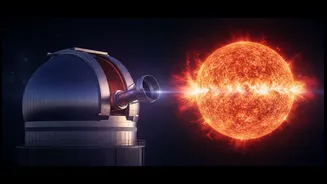
A new era in solar observation is being pioneered by two of the most advanced solar observatories ever built: the ground-based Daniel K. Inouye Solar Telescope (DKIST) in Hawaii and the space-based Solar Orbiter, a joint mission by the European Space
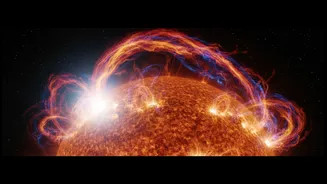
Agency (ESA) and NASA. DKIST, the world's largest solar telescope, provides incredibly detailed views of the sun's lower atmosphere, while the Solar Orbiter travels closer to the sun than previous spacecraft to capture the highest-resolution images of its outer atmosphere, the corona. By combining their data, scientists can create 3D, stereoscopic views of solar phenomena, offering a more complete picture of our star's complex behaviour.
Real-Time Data for a Connected World
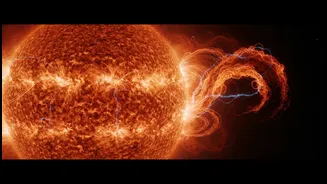
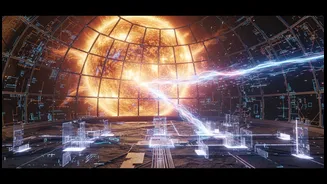
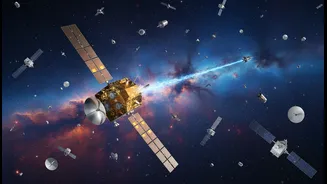
The phrase 'real-time' is key to this revolution. Traditionally, studying the sun involved analysing data long after it was collected. Now, observatories are capable of processing and sharing information almost instantaneously. This is achieved through a combination of highly powered ground-based telescopes, a fleet of satellites, and sophisticated computer models that run simulations. This ability to monitor the sun continuously is crucial for understanding and forecasting 'space weather'—the eruptions of energy and particles from the sun, such as solar flares and coronal mass ejections (CMEs).
Forecasting an Interplanetary Storm
Better solar observation directly translates into better space weather forecasting. These solar outbursts can have significant consequences for our technology-dependent society. A powerful solar storm can damage satellites, disrupt GPS and communication signals, and even bring down power grids on Earth. Recent research suggests the potential effects of extreme space weather might be even larger than previously believed, making advanced warnings more critical than ever. By tracking the sun's magnetic activity, which gives rise to sunspots and storms, scientists can provide more accurate and timely alerts, giving operators time to protect vulnerable infrastructure.
Unlocking Solar Mysteries
Beyond the practical applications, these new observatories are helping to solve long-standing solar puzzles. The coordinated observations between DKIST and Solar Orbiter are providing new insights into phenomena like coronal loops, small-scale flares known as 'campfires', and the processes behind coronal rain, where plasma cools and falls back towards the sun's surface. Understanding these smaller features is vital, as they are believed to play a significant role in the overall dynamics and energy of the solar atmosphere. By studying the sun from multiple perspectives and in unparalleled detail, scientists hope to piece together the full story of how our star works and how it shapes the solar system.
The Next Solar Cycle
This research also improves our ability to predict the sun's 11-year activity cycle. Scientists recently developed a new method for forecasting the strength of the next cycle, Solar Cycle 26, by identifying a specific 'switch-off' point in the current cycle's activity. While an exact prediction is still a couple of years away, early estimates suggest a moderate cycle, potentially weaker than the current one which has produced stunning aurora displays. These long-term forecasts are invaluable for planning future space missions, including crewed voyages to the Moon and Mars, which will need to navigate the hazards of solar radiation.