




The Tyranny of Interplanetary Distance
You can’t just “joystick” a rover on Mars. The biggest hurdle for NASA’s engineers is the immense distance between Earth and the Red Planet. This distance means that radio signals, which travel at the speed of light, take a surprisingly long time to make
the journey. Depending on the planets' positions in their orbits, a one-way signal can take anywhere from about three to 22 minutes to arrive. This means a round-trip communication, where a command is sent and confirmation is received, can take up to 44 minutes. This delay makes real-time control completely impossible. If the rover were approaching a hidden cliff or a patch of soft sand, it would be far too late for an operator on Earth to hit the brakes.
A Meticulously Planned Martian Day
To work around the communication lag, NASA’s rover team operates on a principle of meticulous, delayed gratification. They don’t drive the rover; they give it a detailed to-do list for the next Martian day, or “sol.” A sol is about 40 minutes longer than an Earth day, and for the first few months of a mission, the human team often works on “Mars time,” shifting their schedules daily to stay in sync with the rover. Each day, the process begins with the rover sending back a trove of data from its previous sol's activities via orbiters. This includes science data, engineering health checks, and crucially, 3D images of the terrain directly in front of it. The rover planners at the Jet Propulsion Laboratory (JPL) then spend hours analyzing this information, deciding on the next science targets, and plotting a safe path forward.
Building and Uploading the Plan
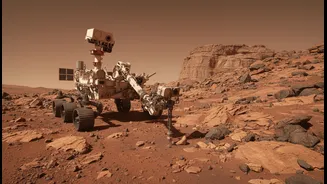
Once a plan is formulated, engineers write a complex sequence of commands. This isn't a simple 'move forward' instruction; it’s a detailed script that might include deploying the robotic arm, zapping a rock with a laser, or driving to a specific set of coordinates. Before this precious command package is sent across millions of miles, it is run through rigorous simulations. JPL maintains an Earth-based, full-scale engineering model of the rover, which allows them to test the plan on a physical twin in a simulated Mars environment called the Mars Yard. Only after the plan is verified for safety and effectiveness is it bundled up and transmitted to Mars, where Perseverance will execute the commands on its own the following sol.
A Brain of Its Own
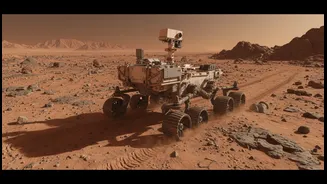
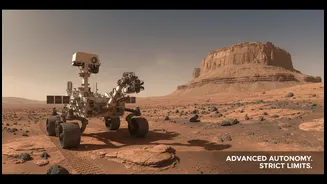
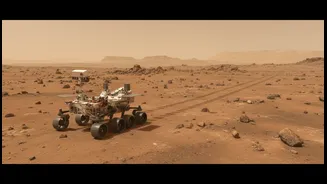
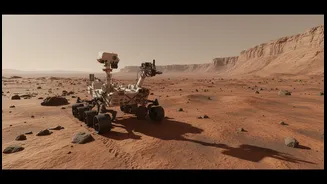
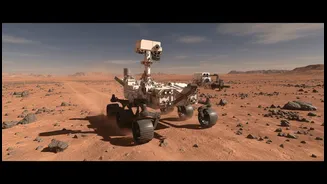
The key to making this marathon possible is the rover's own intelligence. Perseverance is equipped with a sophisticated autonomous navigation system called AutoNav. While human planners provide the general destination or waypoints, AutoNav takes the wheel for the journey itself. Using its stereo cameras, the rover builds its own 3D map of the terrain, identifies potential hazards like large rocks or steep slopes, and plots the safest and most efficient path to its next waypoint. Unlike older rovers that had to stop, think, and then move, Perseverance can perform this analysis while it's still driving, allowing it to cover more ground. Recent upgrades have even given the rover a form of GPS, allowing it to pinpoint its location without help from Earth, and NASA has even tested using AI to generate driving routes, further increasing its autonomy.