



Why Less Can Be More
Cat-Cow, or Marjaryasana-Bitilasana, is a foundational yoga sequence known for warming up the spine. Typically, it's taught with a full arch and round, moving through the entire range of spinal flexion and extension. While this is beneficial for improving
flexibility and relieving stiffness, focusing on a smaller, more subtle movement offers a different set of advantages. For those with sensitive backs, a history of injury, or general stiffness, pushing to the absolute end range can sometimes cause discomfort. By intentionally reducing the movement, you stay in a pain-free zone where your body feels safe. This allows the nervous system to relax, which can help release unconscious muscular tension more effectively than an aggressive stretch. A smaller range also demands more focus, shifting the goal from creating a big shape to feeling the intricate process of the movement itself.
The Art of Internal Listening
This mindful approach is a practice in interoception—the sense of your body's internal state. While proprioception tells you where your body is in space, interoception is about how it feels inside: the stretch in a muscle, the quality of your breath, the subtle shifts in sensation. When you perform Cat-Cow with huge, fast movements, you might miss these signals. Slowing down and shrinking the movement allows you to notice which vertebra initiates the wave-like motion, where tension is held, and how the breath facilitates the stretch. This builds a stronger mind-body connection and enhances your body awareness, which is a key benefit of a consistent yoga practice. You learn to listen to your body's feedback rather than just imposing a shape upon it. This skill is transferable to all other poses and even daily activities, helping you move with more intelligence and safety.
How to Practice with a Small Range
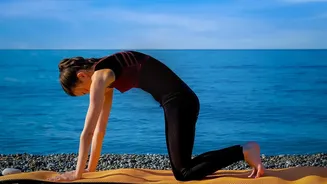
Begin on all fours in a tabletop position, with your wrists directly under your shoulders and knees under your hips. Your spine should be neutral, like a straight line from your head to your tailbone. Instead of aiming for the deepest possible arch on your inhale (Cow Pose), start by initiating a tiny movement from your tailbone, letting it gently tilt upward. Feel how this creates a subtle dip in your lower back. Allow that movement to ripple slowly up the spine, lifting your chest and gaze slightly without crunching your neck.On your exhale (Cat Pose), reverse the movement, again starting from the tailbone. Tuck it under slightly and feel your lower back gently round. Let the curve travel up your spine, drawing your navel in and allowing your head to release naturally. The arch in your back might be very subtle, more of a feeling than a visible shape. The key is to keep the movement slow, fluid, and entirely within a range that feels comfortable and nourishing.
What to Feel For
As you move, bring your full attention to the sensations along your spine. Can you feel the space being created between each vertebra? Notice if one side of your back feels tighter than the other. Pay attention to your abdominal muscles engaging to support the rounding of your back. Synchronize the movement with your breath, letting the inhale guide the gentle arch and the exhale guide the soft rounding. The goal is not to achieve a 'perfect' pose but to cultivate a rich sensory experience. You might discover that these micro-movements provide a more satisfying release for deep-seated tension than a larger stretch does. This is because you are gently mobilizing the small stabilizing muscles around the spine that are often overlooked.
Integrating This Practice
This mindful, small-range approach isn't just for Cat-Cow. You can apply the principle of 'less is more' to many other yoga poses and movements. It is particularly useful as a warm-up to prepare the body for more strenuous activity or as a cool-down to release tension. You can even practice a seated version of this subtle spinal wave while sitting at a desk to alleviate stiffness from prolonged sitting. By prioritising sensation over shape, you develop a more intuitive and sustainable practice. It moves the focus from what your yoga looks like to what it feels like, which is where the most lasting benefits are often found.