
Cosmic Cradles of Creation
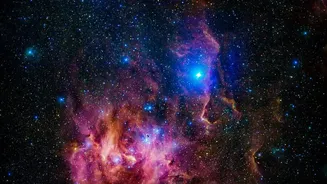
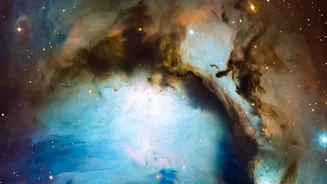
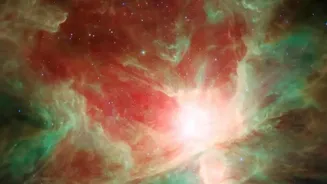
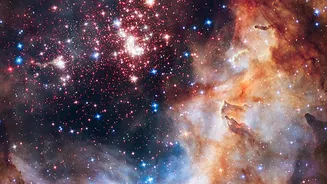
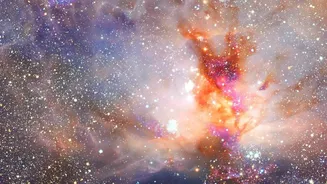
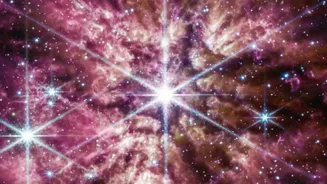
Stellar nurseries are vast, dense clouds of interstellar gas and dust where stars are born. Think of them as cosmic cradles. For immense periods, gravity works to compress these clouds, causing denser clumps to form. Eventually, these cores become so
hot and dense that nuclear fusion ignites, and a new star comes to life. Before the JWST, many of the earliest and most distant of these nurseries were hidden from view, shrouded by the very dust that fuels their star formation.
The Power of a Deep Field
To see the most ancient objects, astronomers engage in a cosmic stakeout. They point a telescope at a tiny, seemingly empty patch of the sky and collect light for hours or even days. This is known as a "deep field." The longer the exposure, the more faint, distant light is captured. Projects like the Cosmic Evolution Early Release Science (CEERS) Survey use this method, stitching together multiple pointings to create a vast mosaic of the early universe. This allows scientists to spot thousands of galaxies, some as they existed when the universe was less than a billion years old.
Webb's Infrared Advantage
The key to Webb's ability is its specialization in infrared light. Light from the most distant galaxies has been traveling for so long that the expansion of the universe has stretched its wavelengths into the infrared spectrum, a phenomenon called "redshift." Visible-light telescopes like Hubble can't see this light. Furthermore, infrared light can penetrate the thick clouds of cosmic dust that obscure the view of visible light, allowing Webb to see directly into the heart of stellar nurseries and witness protostars in the process of forming.
A Toolkit for Cosmic Mapping
To create its stunning maps, Webb uses a suite of powerful instruments. The Near-Infrared Camera (NIRCam) is the primary imager, detecting light from the earliest stars and galaxies. It's responsible for identifying the young, hot stars lighting up their cosmic nurseries. It is complemented by the Mid-Infrared Instrument (MIRI), which excels at seeing the glowing dust itself. MIRI can detect the heat radiating from the dust clouds, revealing their structure and composition. By combining data from NIRCam and MIRI, scientists can create a comprehensive picture, differentiating stars from the surrounding gas and dust to understand how they interact.
Rewriting the Story of Starbirth
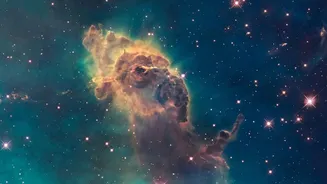
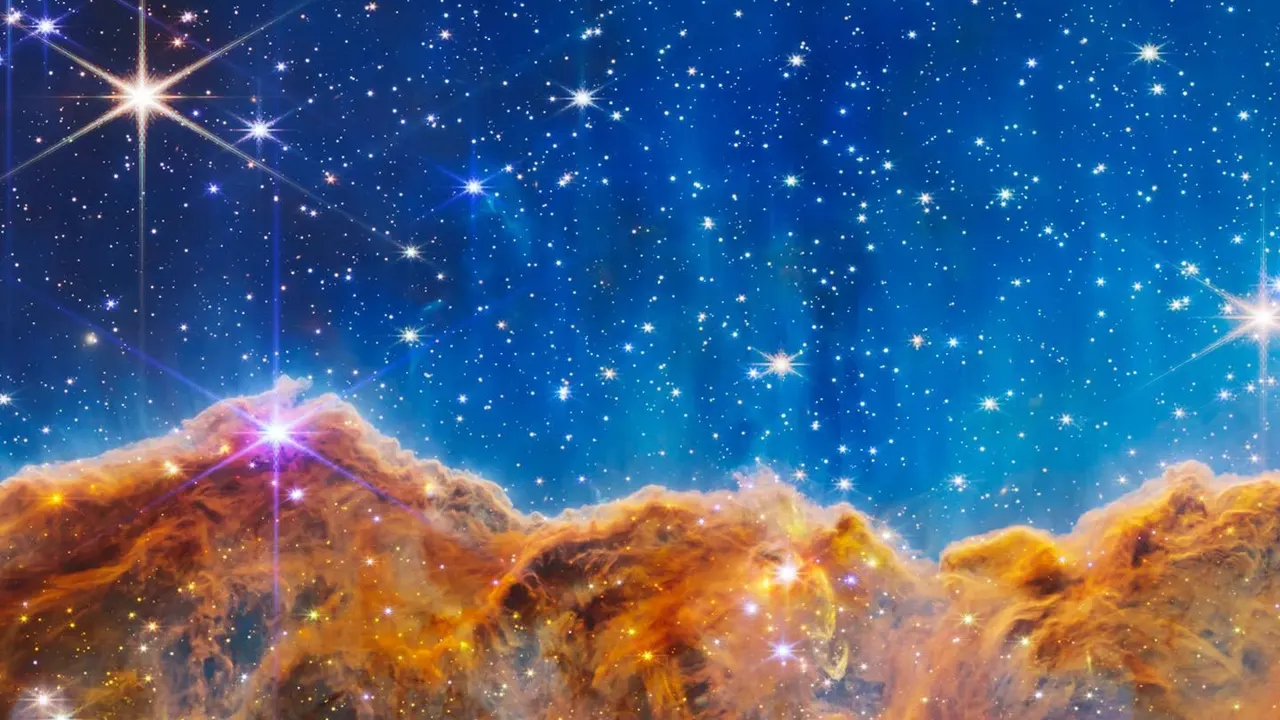
These new maps are already transforming our understanding of the early universe. For the first time, astronomers can study the physical conditions and chemical composition of the earliest star-forming regions. For instance, Webb's observations of regions like the Carina Nebula have revealed dozens of previously hidden outflows from young stars—powerful jets of material that play a crucial role in the star formation process. By studying these ancient nurseries, scientists are gathering clues about how the first galaxies assembled themselves and how the furious star-forming activity in the early cosmos—sometimes hundreds of times more intense than in our own Milky Way today—shaped the universe we see.