






Beyond the Bulky Panel
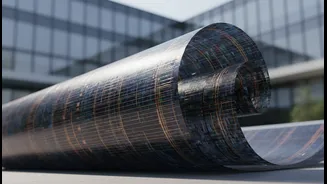
The solar industry is on the verge of a significant transformation, moving beyond the familiar silicon-based panels that have dominated the market. The next frontier is ultra-thin, flexible solar cells, often called energy sheets or films. Unlike their
rigid predecessors, these new cells are created by depositing incredibly thin layers of photovoltaic material onto a flexible substrate. This process, sometimes akin to printing with ink, allows for the creation of solar collectors that are exceptionally lightweight and versatile. Researchers have developed cells thinner than a human hair, capable of generating substantial power while weighing a fraction of traditional panels. This fundamental shift in form factor opens up a world of applications that were previously impractical or impossible.
The Perovskite Revolution
Much of this innovation is driven by a class of materials called perovskites. A perovskite is a material with a specific crystal structure that is remarkably good at absorbing sunlight and converting it into electricity. These materials are not only efficient but can also be manufactured at lower temperatures than traditional silicon, which promises cheaper and less energy-intensive production. By stacking a thin layer of perovskite on top of a traditional silicon cell or another material, scientists have created what are known as 'tandem' cells. This architecture allows the cell to capture a wider range of the solar spectrum, dramatically boosting efficiency. Lab-based records for these tandem cells have soared, with recent announcements in July 2026 citing efficiencies hitting as high as 35.5%, shattering previous benchmarks and even surpassing the theoretical maximum for single-layer silicon cells.
A World of New Possibilities
The true excitement of ultra-thin solar technology lies in its potential applications, particularly in a country as diverse as India. Because they are lightweight and flexible, these energy sheets can be integrated directly into building materials, a concept known as Building-Integrated Photovoltaics (BIPV). Imagine office windows that generate electricity, or curved rooftops and building facades covered in a discreet energy-harvesting skin. The applications extend far beyond static buildings. These flexible cells can be laminated onto vehicles, powering electronics or assisting with propulsion. They can be woven into fabrics for wearable technology or rolled out as portable power mats for remote villages, disaster relief efforts, or military field operations. For India's booming IoT sector, these cells could provide continuous power for countless sensors and tracking devices, eliminating the need for battery replacements.
Thin Film vs. Traditional Silicon
While the promise is immense, it is important to understand the trade-offs. For decades, crystalline silicon panels have become cheaper, more powerful, and highly durable, with most carrying 25-year warranties and retaining high performance over their lifespan. Top-tier commercial silicon panels available in 2026 routinely achieve efficiencies between 22-23%. In contrast, thin-film technologies, while improving, have historically offered lower efficiency and questions remain about their long-term durability in harsh outdoor conditions. A key challenge for perovskite cells has been their sensitivity to moisture and oxygen, though recent advances show significant progress in stability, with some lab devices retaining 90% of their performance after hundreds of hours of continuous operation. The primary advantage of the new sheets is their versatility, low weight, and potential for low-cost, high-volume roll-to-roll manufacturing, which could make them vastly cheaper to produce and install than their rigid counterparts.
The Path to Commercial Reality
Despite a flurry of record-breaking lab results, widespread availability is still on the horizon. The journey from a record-setting laboratory cell to a mass-produced, affordable commercial product is long and fraught with challenges. Scaling up manufacturing from small lab samples to large, uniform sheets, ensuring consistent quality, and reducing production costs are significant hurdles. Governments and corporations are investing heavily, with countries like Japan and China pouring billions into commercializing perovskite technology. Several companies have begun shipping the first commercial perovskite-silicon tandem panels for utility-scale projects. However, for residential and widespread consumer use, most experts believe mainstream availability is still a few years away, likely arriving more broadly between 2027 and 2028 as the manufacturing ecosystem matures.