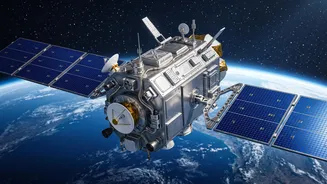


Our modern world runs on an invisible network of satellites orbiting high above. They provide everything from weather forecasts to GPS navigation. But what if that entire system was threatened by a single, devastating event in space?
The Ghost of Starfish Prime
The idea of a nuclear
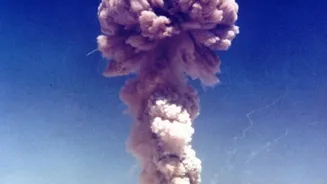
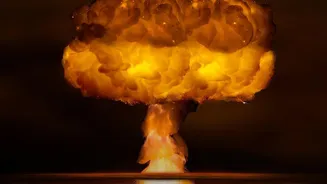
explosion in space isn't just science fiction; it has happened before. In 1962, a US test called Starfish Prime detonated a 1.4-megaton warhead 400 kilometres over the Pacific Ocean. The resulting electromagnetic pulse (EMP) was far stronger than expected, knocking out streetlights and telephone links in Hawaii, nearly 1,500 kilometres away. More importantly for the future, it created a man-made radiation belt that fried the electronics of at least six satellites, including the world's first commercial communications satellite, Telstar 1. At the time, only a few dozen satellites were in orbit. Today, there are over 13,000 in low-Earth orbit alone, forming the backbone of our global infrastructure.
The Double Threat to Satellites
A new, not-yet-peer-reviewed study from researchers at the University of Wisconsin–Madison and Princeton University models what a similar event would do today. The researchers found that a high-altitude nuclear explosion poses two distinct but related threats. The first is the initial burst of X-rays and gamma rays, a form of prompt radiation that would instantly disable any satellite within its line of sight that isn't sufficiently shielded. The second, more insidious threat is what happens next. The explosion releases a massive cloud of high-energy electrons from radioactive decay. Earth's magnetic field traps these electrons, creating an intense, artificial radiation belt that can last for years.
A Cascade of Failures
It's this lingering radiation belt that causes the most widespread damage. A satellite doesn't need to be near the initial blast. As it orbits the Earth, it repeatedly passes through this hostile new environment. With each pass, the radiation dose accumulates, degrading solar panels and frying sensitive electronics until the satellite fails. The simulation showed that a 1-megaton detonation could disable 25% of the low-Earth orbit satellite fleet in one day. After a week, that number would jump to 98%. Even with enhanced radiation shielding, the study found that 99.3% of satellites would still be disabled within a month.
Creating a Debris Field
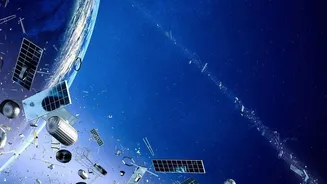
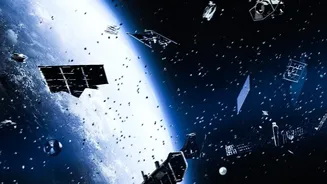
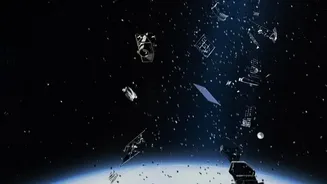
The problem doesn't end with dead satellites. Once a spacecraft loses power, it can no longer be maneuvered. It becomes a piece of uncontrolled space junk, tumbling through a crowded orbit. The study estimates that a mass satellite failure event would lead to about 20 collisions within the first two years. After a decade, these initial collisions could generate around 3,900 new, long-lasting fragments of debris. This creates a cascading problem known as the Kessler Syndrome, where each collision generates more debris, increasing the likelihood of further collisions. This could make low-Earth orbit dangerously unusable for generations, even for new satellites launched to replace the lost ones.
Why Study a Hypothetical Threat?
While placing nuclear weapons in orbit is banned by the 1967 Outer Space Treaty, the renewed focus on space as a domain for military competition makes this research critically important. Our reliance on space is total—from banking and communications to weather monitoring and national security. A mass satellite outage would not cause an immediate societal collapse, but a slow degradation of services we take for granted. Understanding these vulnerabilities is the first step toward building a more resilient space infrastructure. Researchers are exploring solutions like 'hardening' electronics to better withstand radiation and developing more distributed satellite constellations that are less vulnerable to a single point of failure.