







The Push for Clearer Information
For years, the only way to gauge the nutritional content of a packaged food item was to find the fine print on the back. This detailed panel, while comprehensive, is often complex and hard to interpret during a quick grocery run. Amid rising rates of lifestyle
diseases like obesity and diabetes in India, there has been a growing demand from public health advocates and consumers for a simpler system. After years of debate and various proposals, the Food Safety and Standards Authority of India (FSSAI) has put forward a new system for Front-of-Pack Labelling (FoPL) that aims to provide this clarity. The push has been intensified by the Supreme Court, which has repeatedly urged regulators to act swiftly on the matter, framing it as a citizen's right to health.
Introducing the Red Hexagon Warning
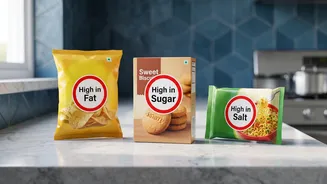
The latest proposal from FSSAI moves away from earlier ideas like a 'Health Star Rating' and instead suggests a direct warning label system. The proposed design is a distinct red hexagon on a white background, to be placed prominently on the upper-left of the package. Inside this hexagon, text will clearly state if the product is 'HIGH IN SUGAR', 'HIGH IN SALT', or 'HIGH IN FAT'. If a product exceeds the threshold for multiple nutrients, they will all be listed within a single hexagon. This model is designed to be impossible to miss and easy to understand, cutting through marketing claims to give a straightforward warning about contents that are a public health concern.
How Will It Work?
The warning labels will be triggered when a food product crosses certain thresholds for added sugar, salt (sodium), and fat. These thresholds are based on the latest Dietary Guidelines for Indians from 2024, developed by the Indian Council of Medical Research-National Institute of Nutrition (ICMR-NIN). Initially, there was debate about whether a warning would appear only if a product was high in two or more nutrients. However, the more recent proposal submitted to the Supreme Court suggests a single-phase system where a warning is triggered if even one nutrient crosses the limit. Certain products like ghee, table salt, sugar, and single-ingredient foods would be exempt. The goal is to flag processed foods that have high levels of these 'nutrients of concern' added during manufacturing.
The Goal: Nudging Healthier Choices
The primary objective of these labels is to empower consumers to make healthier food choices quickly and easily. By placing a clear warning on the front, the system aims to help shoppers, particularly parents and vulnerable groups, identify foods that might contribute to health problems if consumed frequently. This is a form of 'nudging' – using simple cues to guide behavior without restricting choice. The international experience from countries like Chile and Mexico, which have implemented similar warning labels, shows that such systems can significantly alter consumer purchasing habits and encourage manufacturers to reformulate their products to be healthier.
The Debate and The Road Ahead
The path to implementing these labels has been fraught with debate. Food industry groups have raised concerns, arguing that the red colour could be seen as alarming and confusing for consumers. They have also questioned the proposed nutrient thresholds. Conversely, some health advocates have argued initial proposals didn't go far enough, worrying that loopholes might allow some unhealthy products to escape being labelled. The timeline for implementation has also been a point of contention, with the Supreme Court recently questioning FSSAI's proposed long timeline for rollout and urging for faster action. The court has reserved its order on the final framework, indicating that a decision binding on all parties is imminent.