



A Glimpse of the Impossible
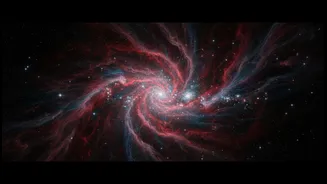
Astronomers using the Hubble Space Telescope, in concert with other powerful observatories, recently detected ionizing ultraviolet light escaping from a galaxy named MXDFz4.4. This may not sound revolutionary at first, but its significance is immense.
The galaxy existed about 13.4 billion years ago, a time when the universe was thought to be largely shrouded in a thick fog of neutral hydrogen gas that should have absorbed such light completely. Observing these photons escape was considered impossible, like trying to see a candle's flame through a dense, miles-thick fog. What makes MXDFz4.4 special is that it is incredibly compact—about 100 times smaller than our own Milky Way—but is furiously creating stars at a rate ten times faster. This observation provides a direct look at a star-forming structure powerful enough to clear its own path.
The Universe in Its Dark Ages
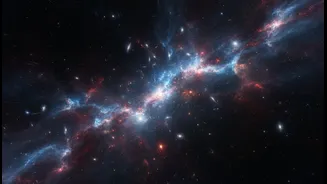
To appreciate this discovery, we need to picture the early universe. After the Big Bang, the cosmos cooled enough for protons and electrons to combine into neutral hydrogen atoms. This event, known as recombination, ushered in a period called the cosmic 'Dark Ages'. For hundreds of millions of years, the universe was devoid of stars and galaxies. It was filled with a vast, uniform fog of neutral hydrogen gas that was opaque to high-energy light. There were no brilliant galaxies to see, no shining stars—just an expansive, featureless darkness. This primordial fog had to be cleared for the universe to become the transparent, star-filled cosmos we know today. The big question has always been: what, exactly, provided the light and energy to do it?
The Great Thaw: What is Reionization?
The process that ended the Dark Ages is called the Epoch of Reionization. It was one of the most important transformations in cosmic history. Over a period of several hundred million years, the universe underwent a fundamental change. The culprits were the very first stars and galaxies to form. These objects began to produce immense amounts of energetic ultraviolet radiation. This radiation was powerful enough to strip the electrons from the neutral hydrogen atoms, or 'ionize' them. This process didn't happen all at once. Instead, bubbles of ionized, transparent space began to form around the earliest light sources. Over time, these bubbles grew larger and began to overlap, until the entire intergalactic fog was burned away, leaving the universe transparent to light.
Connecting Stars to the Dawn
The observation of MXDFz4.4 provides a critical 'smoking gun' that connects these dense star structures to the process of reionization. Theories have long suggested that the first engines of reionization were likely compact, intense regions of star birth, such as the progenitors of today's globular clusters. These ancient star clusters are dense swarms of stars born at the same time. The MXDFz4.4 galaxy, with its burst of massive, hot stars crammed into a tiny space, acts as a perfect real-world example of this theory. The sheer concentration of energy produced by its stars is enough to punch holes in the surrounding hydrogen gas, allowing their ionizing light to escape and contribute to clearing the cosmic fog. For the first time, we are not just modeling this process; Hubble has shown it to us in action.
Why This Matters for Our Cosmic Story
This discovery does more than just confirm a theory; it sharpens our understanding of how the universe evolved. The reionization event wasn't just about making the cosmos transparent. The energy pumped into the intergalactic medium also heated it, which dramatically influenced how subsequent generations of galaxies formed. In particular, this heating process may have prevented very small galaxies from accumulating the gas they needed to grow, effectively setting a minimum size for galaxy formation. By seeing a galaxy like MXDFz4.4 in the act, we get crucial data to refine our models of this complex era. It’s a vital clue that helps us trace the cosmic chain of events from the dark, simple state of the early universe to the complex, structured and illuminated one we inhabit today.