


Decoding a Planet's Breath
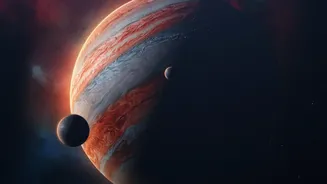
Imagine trying to figure out the ingredients of a cake by only looking at the shadow it casts. That’s essentially how astronomers study the air of planets hundreds of light-years away. The primary technique is called transit spectroscopy. When an exoplanet
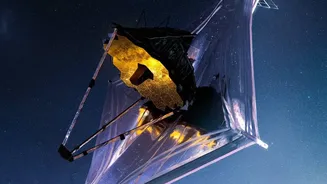
passes in front of its host star from our perspective, a tiny fraction of the starlight filters through the planet's atmosphere. During this transit, gases in the atmosphere absorb specific wavelengths, or colors, of light. This creates a unique chemical 'barcode' embedded in the starlight. By capturing this light and analyzing which colors are missing, scientists can deduce precisely which elements and molecules are present, from water vapor to carbon dioxide. Instruments like those on the James Webb Space Telescope (JWST) are sensitive enough to pick up these incredibly subtle signals, effectively giving us a chemical fingerprint of a distant world.
A Universe of Unexpected Chemistries
Before advanced analysis, theories about other solar systems were often based on our own. But recent discoveries have shattered those assumptions, revealing a stunning chemical diversity. While early finds of water and carbon dioxide on gas giants were groundbreaking, the JWST has opened the floodgates. Scientists are now finding planets with atmospheres rich in carbon-based molecules like methane and benzene, but with very little water. Others have detected sulfur dioxide, a molecule produced by chemical reactions triggered by intense starlight, suggesting active atmospheric chemistry unlike anything in our solar system. This variety tells us that planetary formation is far more complex than previously imagined. The initial mix of elements in the protoplanetary disk, like the carbon-to-oxygen ratio, can lead to vastly different worlds, from 'water worlds' to potential 'carbide planets'.
The Hunt for Signs of Life
The most tantalizing goal of atmospheric analysis is the search for biosignatures—gases or combinations of gases that strongly suggest the presence of life. On Earth, the coexistence of large amounts of oxygen and methane is a dead giveaway; life constantly produces these gases, which would otherwise react and disappear. Finding a similar chemical disequilibrium on a rocky exoplanet in its star's habitable zone would be a monumental discovery. But a biosignature is not just one gas. Scientists are also looking for less common molecules produced by life on Earth, such as dimethyl sulfide—a gas produced by marine life. Detecting these isn't definitive proof of aliens, as non-biological processes can sometimes mimic these signs. However, finding a planet with a cocktail of these gases would make it a prime target for further investigation in our search for life beyond Earth.
More Than Just Habitable Worlds
While the search for life gets the headlines, atmospheric analysis provides a much broader picture of the cosmos. It paints a portrait of worlds that are utterly alien and fascinating in their own right. For instance, studies have revealed 'hot Jupiters' with clouds made of silicates, essentially meaning it could rain glass. The recent investigation of super-Earth 55 Cancri e suggests a blistering lava world with a dynamic atmosphere possibly replenished by volcanic outgassing from its molten surface. Other planets have been found with exotic helium-and-carbon-dominated atmospheres that defy current formation theories. Each of these 'failed' habitable worlds provides crucial data points, helping scientists refine their models of how planets form, evolve, and what strange environments are possible across the galaxy. This chemical census moves exoplanets from being simple statistics to complex, individual worlds with their own stories.