

For decades, we've understood the universe to be about 13.8 billion years old. But what if it were twice that? A recent study from a Canadian university is proposing just that, suggesting our cosmic story might be far longer than we ever imagined.
The Established Consensus
The
13.8-billion-year figure is the cornerstone of modern cosmology, known as the Lambda-CDM model. Scientists arrived at this age by measuring the expansion of the universe and winding the clock backward to a single point: the Big Bang. Evidence for this model is robust, coming from observations of the 'afterglow' of the Big Bang, called the cosmic microwave background (CMB), and the redshift of light from distant galaxies. Redshift is like the Doppler effect for light; as the universe expands, light from faraway objects gets stretched to longer, redder wavelengths, allowing astronomers to calculate their distance and the time the light has travelled.
A New Theory From Ottawa
Enter Rajendra Gupta, a physics professor at the University of Ottawa, who has put forward a new model that pushes the universe's age to a staggering 26.7 billion years. This isn't just a small adjustment; it doubles the cosmic timeline. The theory, called the 'Covarying Coupling Constants plus Tired Light' (CCC+TL) model, revives and combines a couple of older, alternative ideas to present a new picture of cosmic evolution. The primary motivation is to solve some emerging puzzles in astronomy, most notably the 'impossible early galaxy problem'.
The 'Impossible Galaxy' Problem
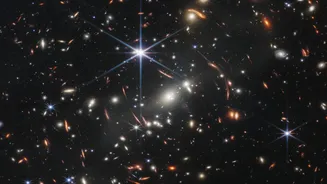
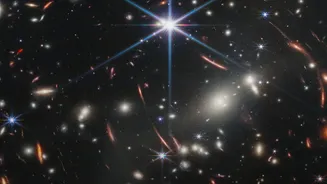
Recent observations from the James Webb Space Telescope (JWST) have revealed galaxies in the very early universe that are surprisingly mature and massive. According to the standard 13.8-billion-year model, these galaxies, seen as they were only a few hundred million years after the Big Bang, shouldn't have had enough time to become so developed. They appear too old for their age. Gupta’s model provides a simple solution: if the universe is actually 26.7 billion years old, these 'early' galaxies would have had billions of additional years to form and grow, resolving the paradox.
How the New Model Works
Gupta’s CCC+TL model introduces two key concepts. First is the 'tired light' theory, which suggests that photons of light lose energy as they travel across vast cosmic distances. This would cause some of the observed redshift, meaning it isn't solely due to the universe's expansion. Second, the model proposes that 'coupling constants'—fundamental forces of nature—may have changed over time. By combining these ideas, the model reinterprets the redshift data, stretching out the timeline. A significant consequence is that this new model may also eliminate the need for dark matter and dark energy, two mysterious components that make up 95% of the universe in the standard model but have never been directly detected.
Awaiting Scientific Scrutiny
While fascinating, Gupta's theory is a bold challenge to a well-established scientific consensus. It is a hypothesis that is just beginning the long process of scientific vetting. The standard Lambda-CDM model successfully explains a huge range of observations, and any new theory must be able to do the same. Proponents note that the CCC+TL model appears consistent with several key observations, such as the abundance of light elements and the rotation of galaxies, without needing dark matter. However, the theory is still under review and must face rigorous testing from the broader physics community before it can be considered a viable alternative, let alone a replacement for the standard story of our universe.