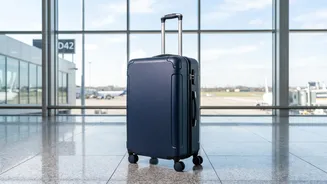







The festive season is upon us, and with it comes the familiar rush of last-minute travel plans. But before you click 'pay' on that flight, a hidden cost could be lurking: baggage fees. Here’s what to double-check to avoid airport stress.
Cabin vs. Checked: Know The Basics
First, a quick
refresher. Cabin baggage is the bag you carry with you onto the plane, while checked baggage goes into the aircraft's cargo hold. The allowances for these are separate and not interchangeable. For domestic economy flights in India, the standard check-in allowance is typically 15 kg per person. The standard cabin allowance is one bag of up to 7 kg. Air India is a slight exception, often allowing 8 kg in the cabin. It is crucial to remember that these are not shared allowances; you cannot pool your family's baggage weight together on most low-cost carriers.
The 'One Bag' Rule and Personal Items
Most Indian airlines adhere to a 'one cabin bag' rule, but many also permit one additional personal item. This could be a laptop bag, a small handbag, or a purse that can fit under the seat in front of you. However, the rules around this personal item vary. IndiGo, for instance, allows a personal item of up to 3 kg separate from your 7 kg cabin bag. Others, like SpiceJet, may count the weight of your personal item within the total 7 kg cabin limit. To be safe, always assume the personal item should be small and light to avoid being asked to consolidate it into your main cabin bag at the gate.
Beware the 'Lite' Fare Trap
In a bid to offer the lowest possible prices, many airlines have introduced 'Lite' or hand-baggage-only fares. These tickets are often significantly cheaper but come with a major catch: they include no free checked baggage allowance. Travellers who book these fares without reading the fine print often get a nasty shock at the airport, where they are forced to pay exorbitant per-kilogram rates to check their bags. If you know you need to check a bag, these fares are almost never the most economical option once you factor in the additional cost.
Excess Baggage: Pre-Book or Pay Dearly
If you know you'll be over the standard 15 kg checked baggage limit, the single most important thing you can do is pre_purchase additional baggage online. The difference in cost is staggering. Paying for excess baggage at the airport can cost anywhere from ₹550 to ₹700 per kilogram, plus taxes. A bag that is just 5 kg overweight could cost you over ₹3,000 at the counter. By contrast, pre_booking that extra weight online through the airline's website or app can be 30_45% cheaper, with costs dropping significantly when purchased in slabs (e.g., an extra 5 kg or 10 kg). This can usually be done up to a few hours before your flight's departure.
Dimension Checks are Getting Stricter
Airlines are becoming more vigilant about the size of cabin bags, not just the weight. The standard dimension limit for a domestic cabin bag is around 55 cm x 35 cm x 25 cm. Many airports now have metal sizers at check_in counters and boarding gates, and if your bag doesn't fit, you may be forced to check it in—often at a high last_minute fee. Don't assume that because your bag is soft, you can squeeze it in. Always measure your luggage, including wheels and handles, before you leave home.
Packing Festive Gifts and Sweets
Travelling during the festive season often means carrying gifts and traditional sweets. Be mindful of the rules here. Dry, solid sweets like barfi, ladoos, and kaju katli are generally fine to carry in either cabin or checked luggage. However, syrupy sweets like gulab jamun or rasgulla are treated as liquids. This means if they are in your cabin bag, they must be in containers of 100ml or less, all fitting within a single transparent 1_litre bag. It's much safer to pack these in a leak_proof container in your checked baggage. Also, be aware that security may ask to unwrap any gift_wrapped items for inspection. Power banks and spare lithium batteries are strictly forbidden in checked luggage and must be carried in your cabin bag.