



The Sun’s Turbulent Threat
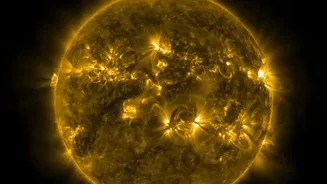
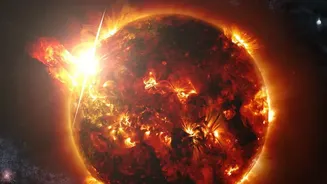
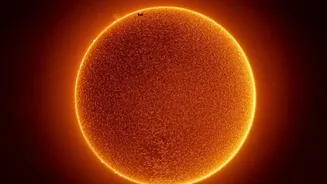
Our sun, the life-giving star at the center of our solar system, has a volatile side. It periodically unleashes massive explosions of plasma and magnetic fields known as Coronal Mass Ejections (CMEs). These events are the primary cause of significant
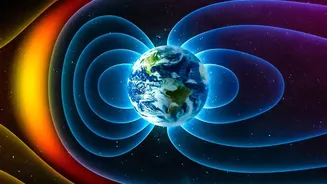
space weather storms. If a CME is aimed at Earth, it can travel the 93 million miles in as little as 15 to 18 hours. When these storms of charged particles interact with Earth's magnetic field, they can have devastating effects on our technology-dependent society. They can induce powerful currents in power grids, leading to widespread blackouts, damage the electronics of critical satellites, disrupt GPS navigation, and interfere with radio communications.
Our Watchful Eye in the Sky
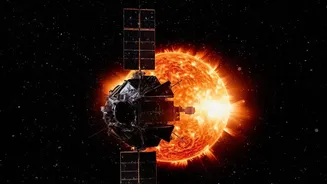
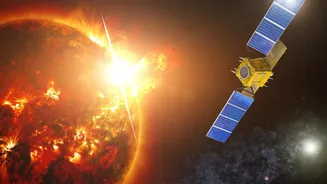
This is where coronagraphs come in. A coronagraph is a specialized telescope designed to do something that seems simple but is technically very difficult: it blocks the overwhelming glare from the sun's bright surface. By creating an artificial eclipse, it allows scientists to see the sun's much fainter outer atmosphere, the corona. It is in the corona that CMEs are born. Instruments like the Large Angle and Spectrometric Coronagraph (LASCO) aboard the SOHO spacecraft and newer compact coronagraphs (CCOR) on GOES satellites monitor this region for transient events, looking for the tell-tale signs of a massive eruption.
Seeing the Invisible Forces
The headline talks about measuring the coronal magnetic field, which is the driving force behind solar eruptions. Directly measuring the magnetic field throughout the vast, tenuous corona is incredibly difficult and, for the most part, not yet possible. Instead, coronagraphs do the next best thing: they observe the plasma (the superheated gas) that is shaped and controlled by these magnetic fields. When scientists see a huge, structured cloud of plasma suddenly erupting and accelerating away from the sun, they are seeing the result of a cataclysmic magnetic event—a process called magnetic reconnection, where stressed magnetic field lines snap and reconfigure, releasing enormous energy. By imaging the plasma in white light, forecasters can infer the size, speed, and direction of the CME.
From Measurement to Warning
This is where the term 'prevention' in the headline becomes relevant. We cannot prevent the sun from producing a storm, but we can prevent the worst of its effects on Earth. Coronagraph imagery is a vital input for space weather forecasting models. Once a CME is detected, forecasters analyze a sequence of images to determine its trajectory and velocity. If it's headed towards Earth, they can predict its arrival time. Satellites like the Deep Space Climate Observatory (DSCOVR), positioned about a million miles from Earth, can provide a final, definitive warning of 15 to 60 minutes when the CME's shockwave passes it. This advance notice allows power grid operators to protect their systems, satellite operators to put their spacecraft into a safe mode, and airlines to reroute flights away from polar regions where radiation is highest.
The Future of Solar Defense
Forecasting is getting better. The recent PUNCH mission, launched in 2025, uses four spacecraft to create 3D observations and can track CMEs almost all the way to Earth, dramatically improving arrival time predictions from a 5-hour window to within 30 minutes. Future missions aim to improve warnings even further. The European Space Agency's Vigil mission, for example, will be positioned at a unique point in space (Lagrange Point 5) to see the 'side' of the sun, detecting hazardous events before they even rotate into view from Earth. These next-generation instruments, combined with advanced computer models, are essential for bolstering our planetary defense against the sun's inevitable fury.