





The Few Seconds That Can Save a Life
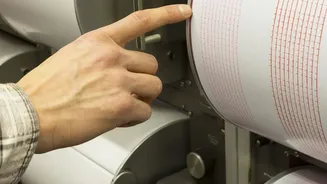
Traditional earthquake detection has relied on highly sensitive, and very expensive, scientific-grade seismometers. These networks are effective but their cost often limits their deployment, leaving vast areas unprotected. An Earthquake Early Warning
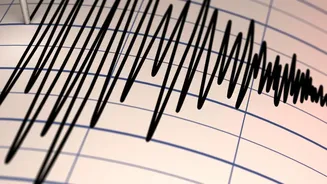
(EEW) system works on a simple principle: it detects the initial, less destructive seismic waves (P-waves) that travel faster than the more damaging secondary waves (S-waves). By detecting the P-wave close to the epicentre, the system can calculate the earthquake's location and magnitude and broadcast an alert to surrounding areas before the destructive S-waves arrive. This can provide a warning of a few seconds to over a minute, depending on the distance from the epicentre. While it doesn't sound like much, this brief window is enough time for people to 'Drop, Cover, and Hold On,' for automated systems to shut off gas lines, and for surgeons to stop procedures, significantly reducing injury and damage.
Your Smartphone, the Accidental Seismometer
The game-changer has been the miniaturisation of technology. The same tiny motion sensors, or accelerometers, that tell your smartphone screen to rotate can also detect the ground shaking from an earthquake. This realisation has led to two major low-cost innovations. The first is creating networks of dedicated, but much cheaper, sensors. A 2019 study in Costa Rica, for instance, used a fixed network of 82 basic smartphones to successfully detect earthquakes. The second, even broader approach, is crowdsourced detection. Google's Android Earthquake Alerts System, launched in India in September 2023, turns the vast network of Android phones into a giant, moving seismic network. When a phone detects shaking consistent with a quake, it sends a signal to a central server. If hundreds or thousands of phones in the same area report similar shaking, the system can confidently confirm an earthquake and issue an alert to users in the projected path of the S-waves.
How the Warning Reaches You
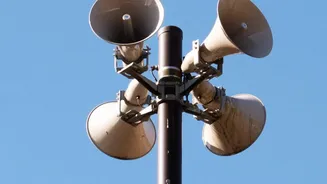
The entire process happens in seconds. For systems like Google's, an alert is typically issued for earthquakes of magnitude 4.5 or greater. Users with Android 5.0 or higher, with location services and the earthquake alert setting enabled, will receive a notification. There are two types of alerts: a 'Be Aware' alert for light shaking and a loud, full-screen 'Take Action' alert for moderate to heavy shaking, which advises protective action like getting under a table. In addition to these large-scale systems, more localised solutions are also being deployed. In the seismically active state of Uttarakhand, the Indian Institute of Technology (IIT) Roorkee has developed a dedicated EEW system with about 170 sensors. This network sends alerts to a specific mobile app called BhuDEV (Bhukamp Disaster Early Vigilantè), as well as to public sirens. This provides a state-specific layer of protection for residents.
Challenges and the Path Forward in India
While this technology holds immense promise, challenges remain. The accuracy of crowdsourced systems depends on having a high density of active smartphones in a given area. In less populated regions, detection may be slower or less reliable. Furthermore, public awareness is key; users need to have the feature enabled on their phones and know how to react when an alert is received. The rollout of Google's system across India, in consultation with the National Disaster Management Authority (NDMA) and the National Centre for Seismology (NCS), is a massive step forward. Localised systems like Uttarakhand's BhuDEV show the power of targeted solutions for high-risk zones. The future of earthquake safety likely lies in a hybrid model, combining data from traditional high-end seismometers, dedicated low-cost sensor networks, and the vast, crowdsourced power of millions of smartphones. This layered approach creates a more resilient and comprehensive network capable of protecting more lives.