




A Day That Outlasts a Year
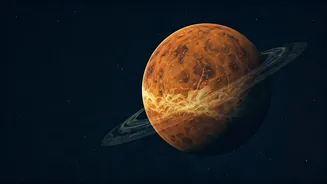
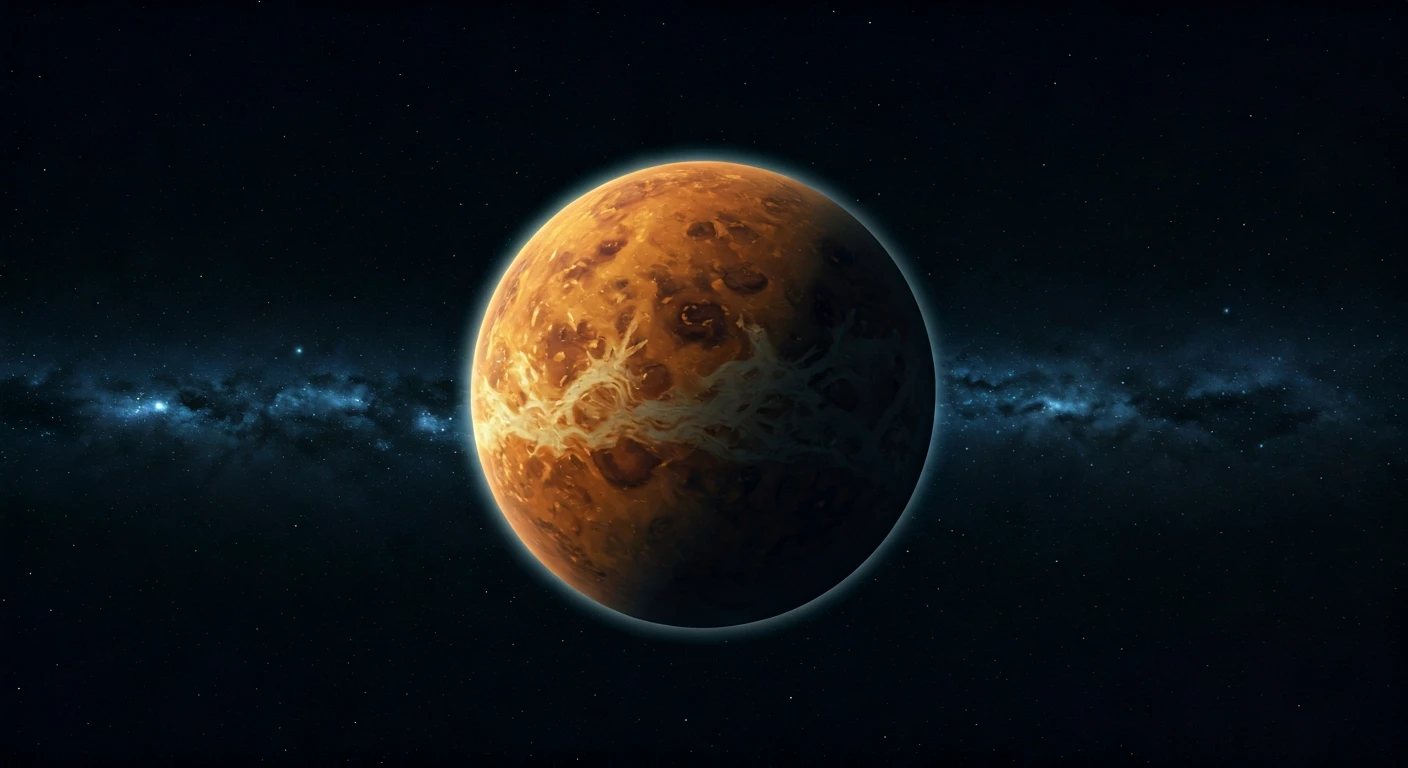
Let's get right to the numbers, because they are staggering. Venus takes about 225 Earth days to complete one orbit around the Sun. That's its year. However, it takes a whopping 243 Earth days for Venus to rotate just once on its axis. This single rotation
is called a sidereal day. So, if you were to measure time by the planet's spin, a Venusian day is about 18 Earth days longer than a Venusian year. It's a concept that is difficult to wrap your head around, as there is nothing like it in our earthly experience. For comparison, Earth completes its orbit in 365 days and spins on its axis once every 24 hours.
Sunrise in the West
The strangeness doesn't stop with the length of its day. Venus also spins backwards compared to Earth and most other planets in the solar system. This is known as retrograde rotation. While on Earth we watch the Sun rise in the east and set in the west, on Venus it would be the opposite. An observer on the surface would see the Sun rise in the west and slowly make its way across the sky to set in the east. But you wouldn't see it happen quickly. The time from one sunrise to the next, known as a solar day, is about 117 Earth days. This means you'd experience nearly two months of daylight followed by two months of night.
Why the Glacial Spin?
Scientists don't have a single, definitive answer for Venus's bizarre rotation, but there are two leading theories. The first, and perhaps most dramatic, is the possibility of a colossal impact early in its history. A massive collision with another planetary body could have been powerful enough to not just slow its spin but completely reverse it. The second major theory involves Venus's incredibly thick and heavy atmosphere. This dense blanket of air, 92 times more massive than Earth's, is thought to create powerful tidal forces. Essentially, the atmosphere drags against the planet's surface, acting like a brake that has slowed its rotation to a crawl over billions of years. It's possible a combination of these factors is at play.
Consequences of a Slow-Motion World
This incredibly slow rotation has had catastrophic consequences for the planet's environment. It is a key factor in making Venus the hottest planet in our solar system, with surface temperatures reaching a staggering 467 degrees Celsius—hot enough to melt lead. The long days and nights contribute to this extreme heat. With the sun beating down on one side for nearly two months straight, the surface temperature soars. While you might expect the night side to cool down significantly, the super-dense carbon dioxide atmosphere traps heat in a runaway greenhouse effect. This thick atmosphere is so efficient at circulating heat that there is very little temperature difference between day and night, or even between the equator and the poles.
Earth's Unlucky Twin
The mind-bending reality of Venus’s rotation serves as a powerful reminder of how planetary evolution can lead to vastly different outcomes. Venus and Earth started out as similar rocky worlds, often called 'sister planets' due to their comparable size and mass. However, their paths diverged dramatically. While Earth developed a stable rotation, a protective magnetic field, and temperate climates, Venus became a scorching, high-pressure world with a day longer than its year. Understanding these differences isn't just about cosmic curiosity; it helps scientists refine their models for planets outside our solar system, teaching us what makes a planet habitable and what can turn it into an inhospitable inferno.