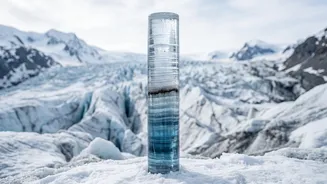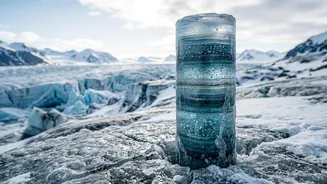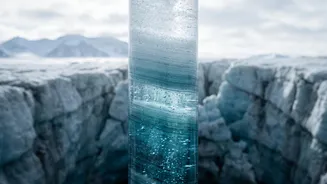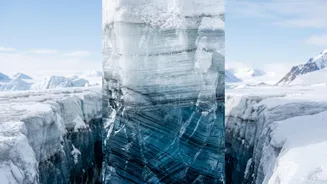






Imagine reading a history book that’s hundreds of thousands of years old, written not in ink, but in ice. That's what scientists do with glacial layers, which hold clues to Earth's past climate. But how can ice in Antarctica tell us about the ocean?
Glaciers as Climate Archives
Glaciers
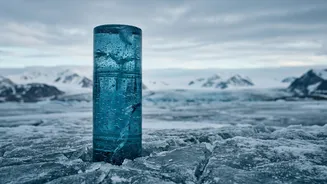
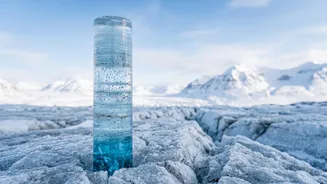
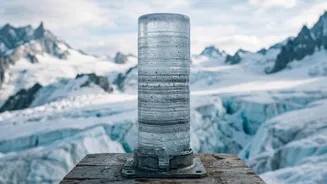
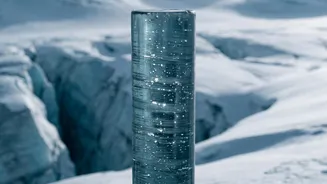
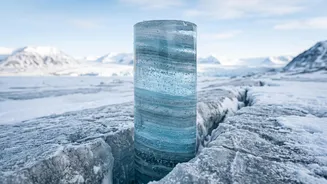
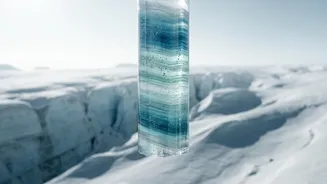
and ice sheets are formed by snow that falls and accumulates over millennia, compacting into dense layers of ice. Each layer traps more than just frozen water; it captures a snapshot of the atmosphere at that moment in time. This includes dust, volcanic ash, and tiny air bubbles containing ancient air. By drilling deep into the ice to extract long cylinders, known as ice cores, scientists can analyze these layers and read the climate record page by page, going back as far as 800,000 years. These cores provide direct evidence of past atmospheric composition, temperature, and precipitation. While a thermometer can tell us today's temperature, these natural archives allow us to reconstruct the climate of the distant past.
The Key: Marine Biomarkers
So, how does this link to the ocean? The key is found in specific organic molecules called biomarkers. These are chemical compounds produced by living organisms. The biomarkers in question come from tiny, single-celled algae that live in the ocean. Certain types of these algae produce molecules called alkenones. The chemical structure of these alkenones changes depending on the water temperature they live in. In warmer water, they produce one type of alkenone, and in cooler water, they produce another. This temperature-dependent production makes alkenones a reliable 'paleothermometer'—a tool for measuring past temperatures.
A Journey from Ocean to Ice
The most fascinating part of the story is how these oceanic biomarkers end up in polar ice, thousands of kilometers away. The journey begins at the ocean's surface. When waves break or bubbles burst, they launch tiny aerosol particles into the air, a process known as sea spray. These aerosols carry the alkenone biomarkers produced by the marine algae. Once airborne, these particles can travel for weeks, carried by global wind patterns high into the atmosphere. Eventually, they are deposited over places like Antarctica and Greenland, where they fall with the snow. As the snow compacts into ice, these biomarkers become locked within the glacial layers, preserving a signal of the ocean's surface temperature from a specific time and place.
Decoding the Chemical Signals
In the lab, scientists carefully melt sections of an ice core and analyze the water for these specific biomarkers. Using sophisticated techniques like mass spectrometry, they can identify and quantify the different types of alkenones present in each layer. By calculating the ratio between the alkenones produced in cold water versus those produced in warm water (a measurement known as the Uk'37 index), researchers can estimate the sea surface temperature at the time and region where the molecules originated. This method has been corroborated by other proxies and is now an established tool for reconstructing ocean temperature history, showing, for example, a significant cooling of about 10°C in the mid-to-late Miocene era.
Why This Ancient History Matters Today
Mapping past fluctuations in sea surface temperature is crucial for understanding the Earth's climate system as a whole. Sea surface temperatures drive weather patterns, influence marine ecosystems, and play a significant role in global climate cycles like El Niño. By reconstructing how oceans have responded to past periods of warming and cooling, scientists can test and improve the climate models we use to predict future changes. Understanding the relationship between ocean temperature, ice sheet stability, and greenhouse gases in the past provides essential context for the rapid changes we are experiencing today, helping us better anticipate what lies ahead for our planet.