




The Sun’s Turbulent Temper
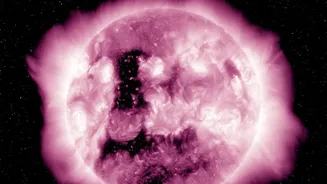
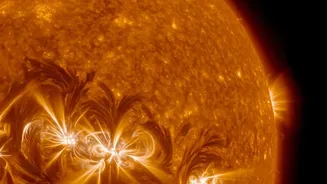
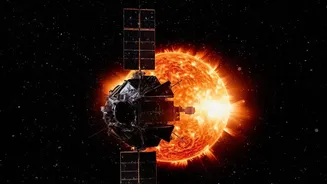
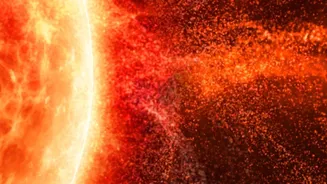
Our Sun isn't just a steady ball of light. Its surface is a churning mass of hot, electrically charged gas called plasma, governed by powerful magnetic fields. Sometimes, these magnetic fields twist and snap, releasing tremendous amounts of energy in an event
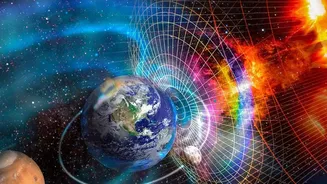
called a solar flare. These are intense bursts of radiation that can reach Earth in just eight minutes. Often accompanying flares are coronal mass ejections, or CMEs. These are even larger events, expelling billions of tonnes of plasma and magnetic fields into space. If a CME is aimed at Earth, it travels across the solar system and can slam into our planet's magnetic shield, triggering what we call a geomagnetic storm. These events are the primary drivers of what scientists call space weather.
When Space Weather Heats Home
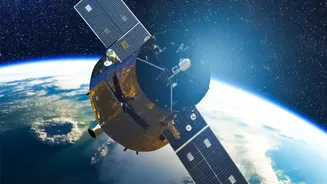
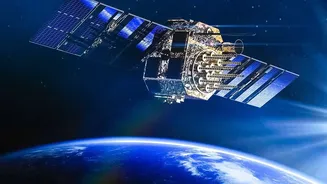
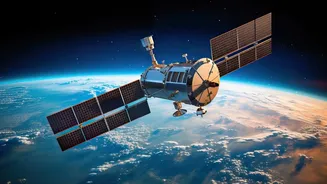
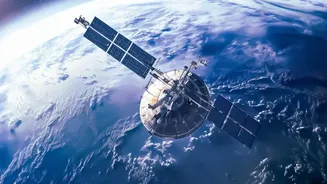
While Earth's magnetic field and atmosphere protect us on the surface from the direct impact of these storms, they have a significant effect on our upper atmosphere. When a CME arrives, it deposits huge amounts of energy into the thermosphere, the layer of the atmosphere that starts about 80 kilometres above the surface. This energy causes the thermosphere to heat up and expand, pushing its boundaries to higher altitudes. This atmospheric expansion might not seem like a big deal, but it dramatically increases the density of the air that satellites in Low Earth Orbit (LEO) have to fly through. This increased density creates more friction, or atmospheric drag, on these satellites. The effect is like a car suddenly having to drive through thicker air; it slows down. This can cause satellites to lose altitude, forcing their operators to perform costly manoeuvres to boost them back into a stable orbit. In a worst-case scenario, the drag can be so severe that it causes satellites to de-orbit and burn up.
A Breakthrough in Forecasting
Predicting the arrival and impact of a CME has been a major challenge. However, recent advances in computer modelling are changing the game. Scientists are now using sophisticated techniques, such as 'ensemble modeling', to improve their forecasts. This approach involves running hundreds of simulations of a single CME event, each with slightly different starting conditions. By comparing these simulations with real-time observations from spacecraft, forecasters can narrow down the possibilities and produce a more accurate prediction. New research, for example, has demonstrated the ability to predict a CME's arrival time at Earth with an accuracy of within half an hour, a tenfold improvement over previous methods that had a five-hour window of uncertainty. These models are not just predicting arrival time, but also a CME's structure, speed, and how it accumulates solar wind material, which helps in forecasting the severity of the atmospheric heating and subsequent drag.
Why Better Predictions Matter
This newfound precision is critical for protecting the technology that underpins modern life. With more accurate and timely warnings, satellite operators can take preventative measures. This might involve temporarily shutting down sensitive electronics or planning orbit-correction burns to counteract the effects of increased atmospheric drag. Beyond satellites, which are essential for everything from GPS navigation and telecommunications to weather forecasting, severe space weather can also disrupt power grids and radio communications. Improved forecasting allows grid operators and airlines, especially those on polar routes, to prepare for potential disruptions. Knowing when a storm will hit and how intense it will be helps mitigate what could otherwise be a trillion-dollar economic impact from a major event.
India's Eyes on the Sun
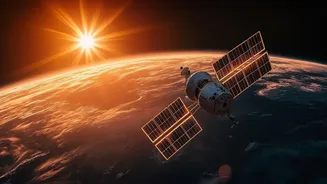
India is playing an increasingly important role in this global effort to understand and predict space weather. The Indian Space Research Organisation's (ISRO) Aditya-L1 mission is a dedicated solar observatory positioned at a unique vantage point 1.5 million kilometres from Earth. This allows it to continuously monitor the Sun without interruption. Aditya-L1's suite of instruments studies solar flares, CMEs, and the solar wind, providing crucial data that feeds into these advanced forecasting models. By contributing to the global understanding of solar dynamics, the mission not only pushes the boundaries of science but also helps safeguard India's own growing fleet of satellites and technology infrastructure from the Sun's unpredictable temperament.