



Pattachitra: The Narrative Scrolls
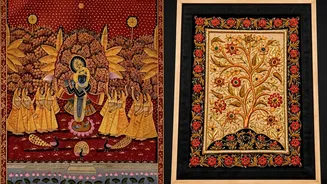
In the heritage village of Raghurajpur, nearly every home is an artist's studio. This is the heartland of Pattachitra, a traditional form of cloth-based scroll painting that dates back centuries. The name itself comes from the Sanskrit words 'patta' (cloth)
and 'chitra' (picture). These intricate artworks are known for their mythological narratives, particularly tales of Lord Jagannath, and are rendered in bold, natural colours derived from minerals and plants. Artisans, known as Chitrakars, first prepare the canvas with a mix of chalk and tamarind seed paste before sketching and painting stories from epics like the Ramayana and Mahabharata. Visiting Raghurajpur, just a short drive from Puri, offers the chance to see this meticulous process firsthand and purchase these timeless pieces directly from the families who have preserved the art for generations.
Tarakasi: The Silver Filigree of Cuttack
Cuttack, known as the 'Silver City of India', is the epicenter of Tarakasi, the delicate art of silver filigree. This craft, with a history spanning over 500 years, involves drawing silver into fine threads and wires, which are then twisted and soldered into exquisite, lace-like designs. The technique may have been influenced by trade with Persia and Indonesia, but Odia artisans have made it distinctly their own. Tarakasi is used to create stunning jewellery, including the intricate pieces worn by Odissi dancers, as well as decorative items and religious offerings for temples. The magnificent silver backdrops, or 'Chandi Medhas', seen during Cuttack's famous Durga Puja celebrations are a testament to the grand scale and breathtaking skill of Tarakasi artists.
Appliqué Work: The Colours of Pipili
Located on the highway between Bhubaneswar and Puri, the town of Pipili bursts with colour. This is the home of 'Chandua', the traditional appliqué craft. The technique involves stitching brightly coloured pieces of fabric onto a base cloth to create vibrant and intricate patterns of flowers, animals, and mythological figures. The origins of this art form are deeply connected to the Jagannath Temple in Puri, where it has been used for centuries to create canopies, umbrellas, and decorations for the annual Rath Yatra. Today, the artisans of Pipili apply their skills to a wide range of items, from handbags and lampshades to wall hangings and garden umbrellas, making it a can't-miss stop for anyone seeking a piece of Odisha's festive spirit.
Dhokra: The Lost-Wax Metal Casting
Dhokra is an ancient tribal art of non-ferrous metal casting using the lost-wax technique, a method that dates back over 4,000 years to the Indus Valley Civilization. Practiced by the Dhokra Damar tribes, this craft is found in several parts of Odisha, including Dhenkanal and Rayagada districts. The process is fascinating: a clay core is made, covered in beeswax, and intricately carved. This wax model is then coated in clay again, and molten brass is poured in, melting the wax and taking its place. The result is a rustic, one-of-a-kind metal object. The motifs are inspired by tribal culture and folklore, often depicting deities, animals, and ritual objects. These striking figurines and jewellery pieces embody a primitive simplicity and a forceful, enchanting form.
Ikat: Poetry on the Loom
Odisha's handloom tradition is world-renowned, and at its heart is the Sambalpuri Ikat. Known locally as 'Bandhakala' or the 'art of tying', this technique is a marvel of precision. Before the threads are even placed on the loom, the yarn is tie-dyed in predetermined patterns. As the fabric is woven, these dyed threads come together to form intricate, curvilinear motifs like shells, wheels, and flowers, which appear identically on both sides of the cloth. This complex process, often called 'poetry on the loom', is practiced in the western districts of Odisha, such as Sambalpur and Bargarh. The resulting sarees and textiles are celebrated globally for their unique beauty and the immense skill they represent.