



In a world that never seems to switch off, finding true rest can feel impossible. Even when we try to relax, our minds often keep racing. Yoga Nidra offers a solution: a powerful technique that guides you into a state of profound calm.
What Exactly Is Yoga Nidra?
Yoga Nidra, often
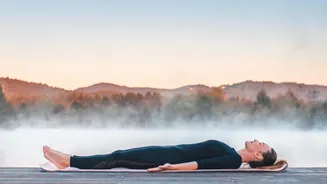
translated as 'yogic sleep', is a guided meditation practice that induces a state of deep relaxation between wakefulness and sleep. Unlike a nap, the goal is not to fall completely unconscious, but to remain aware while the body and mind rest completely. It is a systematic method of moving your awareness through your body, breath, and inner world, leading to a state where you are exceptionally calm but still conscious. This practice is always done lying down comfortably on your back in a posture known as Savasana (corpse pose), making it accessible to almost everyone, regardless of physical fitness or experience with yoga.
The Science of Deep Rest
The benefits of Yoga Nidra are not just anecdotal; they are rooted in its effect on the nervous system. The practice helps shift the brain from the active, 'fight-or-flight' sympathetic nervous system to the restful, 'rest-and-digest' parasympathetic nervous system. This transition can lead to a host of measurable benefits. Studies and practitioners report significant reductions in stress and anxiety, improved sleep quality, and a greater sense of overall well-being. By entering this unique state of consciousness, the body gets the deep rest it needs to repair and rejuvenate, which can be more restorative than an equivalent amount of conventional sleep where the mind might still be processing worries.
The Stages of a Session
A typical Yoga Nidra session follows a specific sequence designed to gently guide you into a state of deep relaxation. It usually begins with setting a 'Sankalpa', or a heartfelt intention, which is a short, positive statement you plant in your subconscious. The guide will then lead you through a 'body scan', a process of bringing awareness to each part of your body, one by one, without moving. This is followed by a period of breath awareness, where you simply observe the natural rhythm of your breath. The practice may also include the visualization of opposite sensations (like heat and cold) and imagery to occupy the mind and prevent it from wandering. Finally, the session concludes by gently revisiting your Sankalpa before being guided back to full wakefulness.
How to Begin Your Practice
Getting started with Yoga Nidra is simple. You do not need any special equipment, though a yoga mat, blanket, and a small pillow for your head can enhance comfort. The easiest way to begin is by using a guided audio recording. There are thousands of free and paid options available on platforms like YouTube, Spotify, and various meditation apps. Find a quiet, comfortable space where you will not be disturbed for 20 to 40 minutes. Lie down on your back with your arms resting by your sides, palms facing up. Cover yourself with a blanket, as your body temperature can drop during deep relaxation. Put on your chosen guided recording, close your eyes, and simply follow the instructions without trying too hard. The key is to let go and allow the experience to unfold naturally.
Tips for a Deeper Experience
To get the most out of your practice, consistency is more important than duration. A regular 20 minute session can be more beneficial than an occasional hour long one. It is also completely normal if you fall asleep especially when you first start. It is often a sign that your body is sleep deprived and in need of rest. With time you will learn to hover in the state between waking and sleeping. Do not judge your practice there is no right or wrong way to feel. Some days you might feel profoundly relaxed while other days your mind may feel busy. Simply showing up and allowing yourself this time to rest is the practice itself.