



Aperture: The Light Gathering Gateway
Think of your camera's aperture as its pupil. It’s the opening in the lens that allows light to hit the sensor. In deep space photography, your targets—like nebulae and distant galaxies—are incredibly faint. Your primary challenge is to gather as much
of their scarce light as possible. This is where aperture becomes king. A wider aperture, denoted by a lower f-number (like f/2.8 or f/4), means a larger opening. This allows your camera to collect more light in a shorter amount of time. While a kit lens might have an aperture of f/3.5, a specialised lens with a wider f/2.8 aperture can make a huge difference, gathering significantly more photons. For deep-sky objects, you want to maximize the light hitting your sensor, and a wide aperture is the first and most critical step to achieving a bright, detailed image rather than a dark, empty frame.
ISO: Amplifying the Faint Signal
If aperture is about how much light you let in, ISO is about how sensitive your camera's sensor is to that light. Increasing the ISO makes the camera amplify the signal from the sensor, effectively brightening the image without changing the exposure time or aperture. This seems like a perfect solution for faint objects, but there’s a crucial trade-off: noise. Pushing the ISO too high amplifies not just the light signal, but also electronic interference, which appears as a grainy texture or 'noise' in your image. However, the old belief that high ISO always equals a bad, noisy image is more complicated in astrophotography. For many modern cameras, a moderately high ISO (like 1600 or 3200) can actually produce a better signal-to-noise ratio than a very low one. The goal is to find your camera's sweet spot, where the signal is sufficiently amplified without the noise becoming overwhelming. Remember, ISO doesn't add more light; it just makes the most of the light you've already captured.
Tracker Mounts: The Unshakeable Foundation
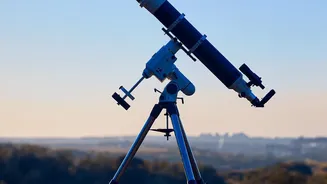
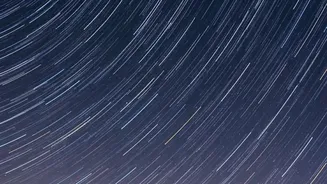
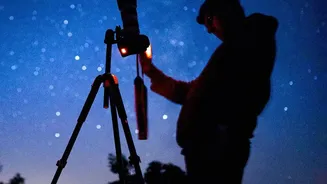
Here is the component that separates casual night-sky snapshots from serious deep space astrophotography: the equatorial tracker mount. As Earth rotates, the stars appear to move across the sky. If you take a long exposure photo—which is essential for capturing faint objects—this movement will cause the stars to appear as streaks or trails. A standard tripod can't prevent this. An equatorial mount is a specialized, motorized tripod head designed to counteract Earth's rotation. By aligning the mount with the Earth's polar axis, it can track a celestial object with remarkable precision, keeping it perfectly centred in your frame for minutes at a time. This stability is what allows you to use the long exposure times—often several minutes per shot—needed to collect enough light from a galaxy millions of light-years away. Without a tracker, long-exposure astrophotography is simply impossible.
The Three Pillars in Harmony
These three elements don't work in isolation; they form a symbiotic relationship known as the exposure triangle. A tracker mount provides the essential stability needed for long exposures. This freedom to shoot for minutes, instead of seconds, means you can gather more light without immediately resorting to a high ISO. You can open your aperture wide (low f-number) to maximize the amount of light entering the lens. With the light pouring in over a long, stable exposure, you can then set your ISO to a moderate level that amplifies the signal effectively without introducing excessive noise. For example, a tracker allows a 3-minute exposure. This long duration lets a wide f/2.8 aperture gather a huge amount of light from a faint nebula. An ISO of 1600 then brightens that collected data into a visible image, whereas without the tracker, a 20-second exposure would have left you with a dark, unusable frame.