
Peeking at the Sun’s Hidden Crown
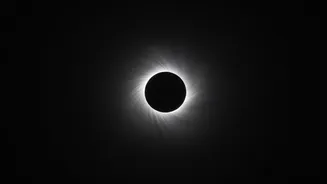
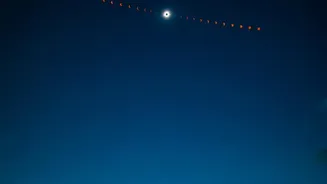
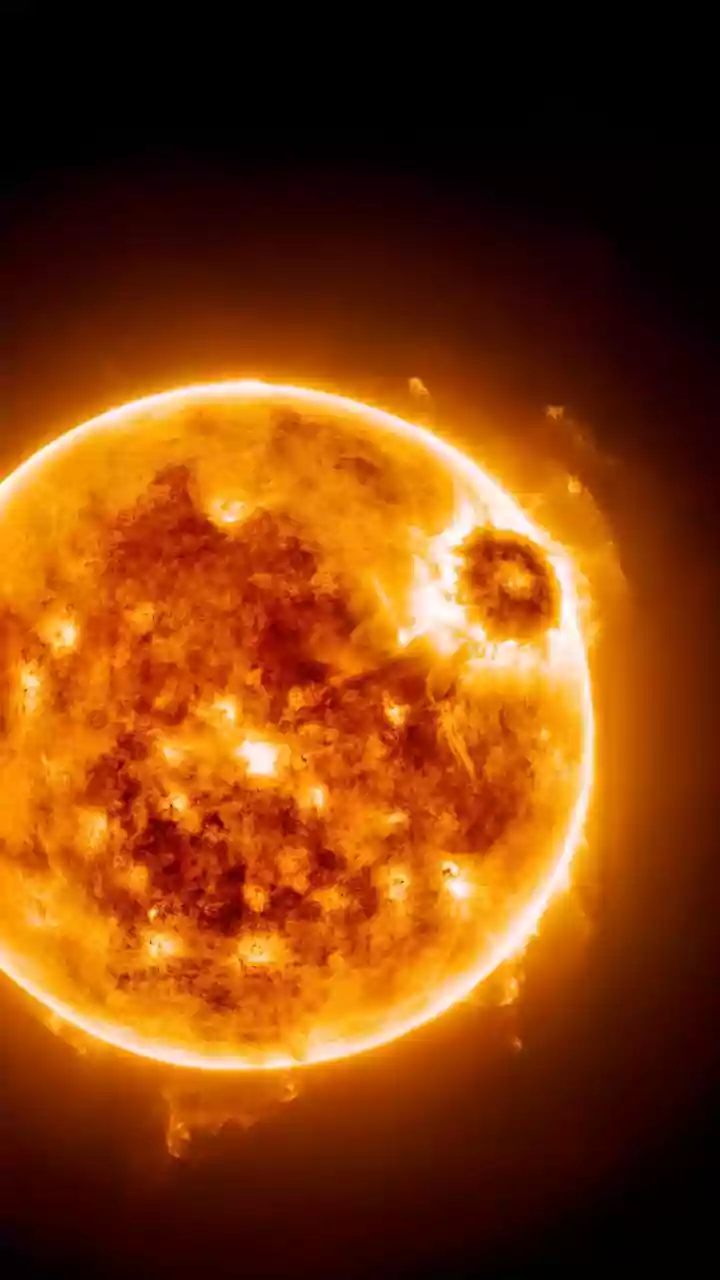
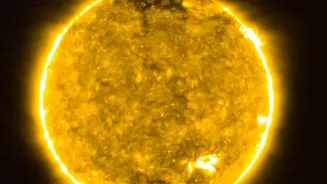
The single biggest reason scientists eagerly await total solar eclipses is to get a clear view of the Sun's corona. This is the star's outer atmosphere, a wispy, ethereal halo of plasma that stretches millions of kilometres into space. The corona is incredibly
hot, reaching temperatures of millions of degrees Celsius, far hotter than the Sun's surface below. However, it is also about a million times fainter than the Sun's main disk, making it completely invisible under normal circumstances. During totality, the Moon acts as a perfect natural shield, blocking the blinding glare of the Sun's surface and allowing the ghostly light of the corona to shine through in stunning detail. This brief window allows researchers to study its complex structure of loops and streamers, which are shaped by the Sun’s powerful magnetic fields.
A Superior Natural Instrument
You might wonder if we have technology that can create an artificial eclipse. We do—it's called a coronagraph. These instruments, both on the ground and in space, use a small, solid disk to block the Sun's light inside a telescope. While incredibly useful for daily monitoring, coronagraphs have limitations. They struggle to block the Sun's light perfectly without also obscuring the innermost part of the corona, which is a critical region for understanding solar physics. Stray light often bleeds around the artificial disk, obscuring the faintest details. A total solar eclipse, with the Moon positioned far from our atmosphere, provides a much cleaner and more complete view of the lower and middle corona, offering data that complements what our satellites can gather.
Understanding Space Weather
Studying the corona isn't just an academic exercise; it's key to understanding space weather. The corona is the source of the solar wind, a continuous stream of charged particles that flows outward and bathes our entire solar system. This wind, along with more violent eruptions like coronal mass ejections (CMEs), can have significant impacts on Earth. They can disrupt satellite communications, damage power grids, and even pose a risk to astronauts in space. By observing the corona during an eclipse, scientists can better understand how the solar wind is accelerated and how these massive eruptions are born, helping to improve our ability to forecast potentially disruptive space weather events.
A Laboratory in Our Atmosphere
The effects of a solar eclipse are not limited to space. The sudden, localized cutoff of sunlight provides a unique opportunity to study Earth's own atmosphere. As the Moon's shadow races across the planet, it causes rapid changes in temperature, wind patterns, and humidity. More importantly, it dramatically affects the ionosphere, the electrically charged upper layer of our atmosphere. This layer, which is crucial for long-distance radio communications, is created by the Sun's radiation. During an eclipse, the sudden drop in radiation can cause temporary 'holes' or depletions in the ionosphere, allowing scientists to study its response in a controlled, predictable experiment. This helps them understand how the ionosphere reacts to solar fluctuations, which can impact GPS and communication systems.
A Testbed for Fundamental Physics
Historically, eclipses have been central to some of science's greatest breakthroughs. One of the most famous examples occurred during the total solar eclipse of May 29, 1919. British astronomer Arthur Eddington led expeditions to observe starlight passing near the eclipsed Sun. According to Albert Einstein's new theory of general relativity, the Sun's immense gravity should bend spacetime, causing the light from distant stars to appear to shift its position. This was impossible to measure normally. By observing the stars' positions during the eclipse and comparing them to their normal positions at night, Eddington's team confirmed that the light did indeed bend as Einstein predicted, providing one of the first major pieces of evidence for his revolutionary theory.