



A Galaxy of Beautiful Chaos
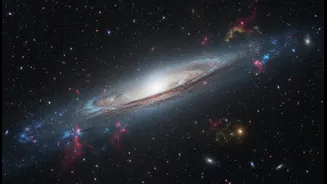
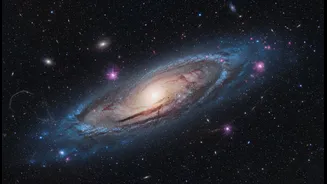
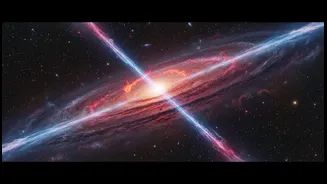
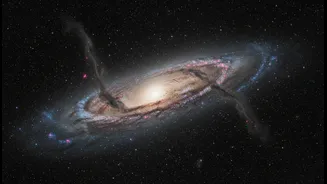
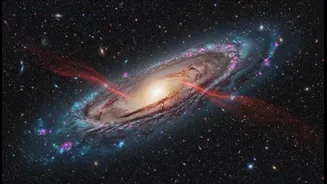
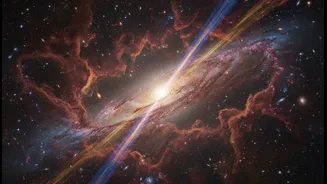
At a mere 12 million light-years away, Centaurus A is one of our closest galactic neighbours and a subject of intense astronomical fascination. It’s known as an 'active galaxy' because its central supermassive black hole is furiously consuming matter
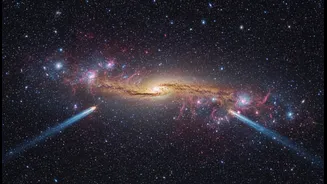
and blasting out powerful jets of energy. This chaotic activity stems from a dramatic past; Centaurus A is the result of a colossal merger between a large elliptical galaxy and a smaller spiral galaxy millions of years ago. This collision left behind a distinctive, warped disc of dust that has long hidden the galaxy's heart from view. Telescopes like Hubble could see the dark dust lanes, but not what lay behind them. Now, Webb's powerful infrared vision has pierced through that veil, transforming our view of this cosmic marvel.
For the Everyday Space Reader: A Story Written in Starlight
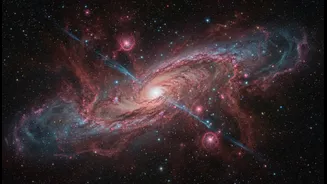
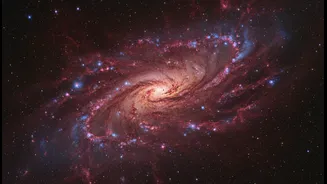
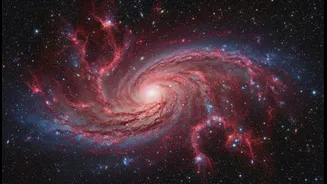
For the casual enthusiast, the new Webb image is pure cosmic drama. Where previous images showed a bright glow obscured by a dark slash of dust, Webb reveals a glittering tapestry of millions of individual stars. The 'grainy' texture of the image isn't noise; it's countless points of light, each a star with a story. This unprecedented clarity allows us to witness the aftermath of a galactic collision in stunning detail. The glowing red filaments and strange, S-shaped structures are regions of intense star birth, sparked by the ancient merger. By seeing through the dust, Webb allows us to look back in time. We can now see the brilliant glow of young star clusters and trace the skeletal remains of the spiral galaxy that was consumed. It turns a static object into a dynamic scene of creation and destruction, making the universe feel more alive and accessible than ever.
For the Ambitious Student: A Galactic Archaeology Site
For students of astronomy and physics, this image is a treasure trove of data. Centaurus A is a perfect laboratory for studying phenomena that are crucial to understanding the universe. With Webb's ability to resolve individual stars within the galaxy's core, scientists can now engage in 'galactic archaeology'. By studying the age, distribution, and composition of these stars, they can create a precise timeline of the galaxy's evolution. This includes pinpointing when the original burst of star formation happened after the merger, how the supermassive black hole influences its surroundings, and how gas and dust are recycled to form new stars and planets. Webb's instruments can also measure the motion of gas swirling around the black hole, providing direct evidence of how these cosmic engines shape their host galaxies. For the first time, theories about galactic mergers and black hole feedback can be tested with crystal-clear observational data from a nearby example.
For the Visual-Science Fan: A Technical Masterpiece
For those who appreciate the intersection of science and art, the image is a triumph of technology. Its stunning detail is made possible by Webb's specialisation in infrared light. Unlike the visible light captured by Hubble, infrared radiation can pass through dense clouds of cosmic dust, effectively making the opaque transparent. The new image is a composite from Webb's Near-Infrared Camera (NIRCam) and Mid-Infrared Instrument (MIRI), which capture different wavelengths to reveal different features. NIRCam resolves the millions of individual stars, while MIRI highlights the glowing, intricate structures of warm dust, revealing where new stars are forming inside their dusty cocoons. The processing that translates this invisible light into a breathtaking visual is an art in itself, assigning colours to different infrared wavelengths to highlight scientific features. The characteristic eight-pointed diffraction spikes on the brightest stars are a signature of Webb's unique hexagonal mirror segments, a visual reminder of the incredible engineering behind this cosmic view.