




The Old Ways of Finding Worlds
For decades, astronomers have relied on two main techniques to find exoplanets, which are planets orbiting stars other than our sun. The most successful is the 'transit method', used by missions like NASA's Kepler and TESS. This involves watching a star for
a tiny, periodic dip in its brightness, which can indicate a planet is passing in front of it from our point of view. Another common technique is the 'radial velocity' or 'wobble' method, which detects the slight gravitational tug a planet exerts on its star, causing it to wobble back and forth. While incredibly effective, these methods are best at finding large planets that orbit very close to their stars. They have limitations when it comes to finding smaller, more distant worlds, or planets that exist in the vast darkness between stars.
Einstein's Cosmic Magnifying Glass
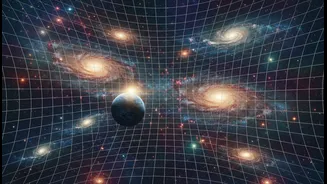
Over a century ago, Albert Einstein's General Theory of Relativity revolutionised our understanding of gravity. He proposed that massive objects don't just pull on other objects, but actually warp or curve the fabric of space-time around them. Light, which travels through space-time, has to follow these curves. Einstein himself predicted in 1936 that if a massive object, like a star, passed perfectly in front of a more distant star, its gravity would act like a lens, bending and magnifying the background star's light. He thought the chances of such a perfect alignment were too slim for it to be a useful observational tool. For once, he was wrong. This effect, now called gravitational microlensing, is a powerful new way to see the unseen.
Catching a Planetary Glitch
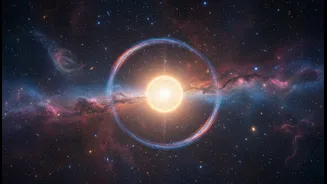
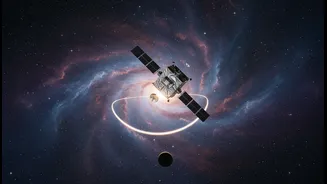
Here is how it works in practice: astronomers monitor dense fields of stars, like those towards the center of our Milky Way galaxy, waiting for a chance alignment. When a foreground 'lens' star drifts in front of a distant 'source' star, the source star's light will smoothly and symmetrically brighten and then fade over days or weeks as it passes through the gravitational lens. But if that foreground star has a planet, the planet's own smaller gravity adds its own little warp to space-time. As the alignment continues, the planet can create a second, much shorter and sharper spike of brightness in the light we observe. This 'planetary glitch' is the tell-tale sign of a planet. The characteristics of this brief flare-up allow scientists to calculate the planet's mass and its distance from its host star.
Finding the Universe's Lost Wanderers
The true power of microlensing is its ability to find planets that other methods simply cannot detect. It is uniquely sensitive to planets with Earth-like masses in wide orbits, similar to the planets in our own solar system. It can find planets orbiting very faint stars, or stars thousands of light-years away, far beyond the reach of the transit or wobble methods. Perhaps most excitingly, gravitational microlensing is the only technique capable of finding 'rogue planets' — worlds that have been ejected from their original star systems and now wander alone through the galaxy. These ghostly worlds cause very brief microlensing events, sometimes lasting only a few hours, without the main brightening from a host star. In recent years, several candidate rogue planets, including some as small as Earth, have been reported using this method.
A New Era for Planet Hunting
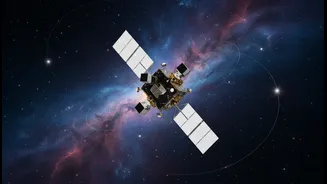
While it currently accounts for only a small fraction of the 6,000+ exoplanets discovered to date, microlensing is a rapidly growing field. In a recent breakthrough, scientists even used data from NASA's TESS satellite—which was designed for the transit method—to confirm a microlensing planet 40,000 light-years away, showcasing the versatility of our observatories. The future is bright for this technique. The European Space Agency's Euclid telescope and NASA's upcoming Nancy Grace Roman Space Telescope are both designed to conduct massive microlensing surveys. The Roman telescope, in particular, will stare at the crowded heart of the Milky Way, where microlensing events are more common, and is expected to discover around 1,000 new planets this way, revolutionizing our census of alien worlds.