





The Sideways Planet's Biggest Puzzle
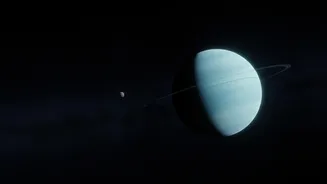
The most defining and baffling feature of Uranus is its extreme tilt. While other planets spin like tops as they orbit the sun, Uranus rolls along on its side, with its axis tilted a staggering 98 degrees. This bizarre orientation results in the most extreme seasons
in the solar system, with each pole facing 42 years of continuous sunlight followed by 42 years of complete darkness. The leading theory for this peculiar tilt is a cataclysmic collision with an Earth-sized object billions of years ago during the solar system's chaotic formation. However, other theories are also being explored. Some scientists propose that multiple smaller impacts could have knocked it over, while another fascinating hypothesis suggests a large, long-lost moon could have slowly pulled the planet onto its side through gravitational interactions before crashing into Uranus and disappearing.
A Weird and Wonky Magnetic Field
When NASA's Voyager 2 spacecraft flew past Uranus in 1986—the only mission to ever visit the planet—it discovered a magnetic field unlike any other. Instead of being aligned with the planet's rotational axis, like Earth's, Uranus's magnetic field is tilted by nearly 60 degrees. It's also significantly offset from the planet's physical center. This makes for a chaotic and lopsided magnetosphere that wobbles dramatically as the planet rotates. Scientists are still trying to understand what generates this strange field. On Earth, the magnetic field is produced by the convection of its molten iron core. The unusual nature of Uranus's field suggests it may be generated in a shallower, slushy layer of water, methane, and ammonia ices, rather than its core.
The Coldest Planet in the System
Despite being over a billion miles closer to the Sun than Neptune, Uranus holds the record for the coldest temperatures ever recorded in the solar system, with its atmosphere dipping as low as -224°C. This is a major puzzle because planets are expected to be warmer the closer they are to the sun. Furthermore, Uranus radiates very little internal heat, unlike Jupiter, Saturn, and Neptune, which all emit more heat than they receive. One theory links this back to the giant impact that may have tilted the planet, suggesting the collision could have caused Uranus to vent most of its primordial heat into space. Another idea is that its layered interior prevents heat from the core from reaching the surface.
A Call for a Return Mission
The discovery of a new moon, provisionally named S/2025 U1, via the James Webb Space Telescope underscores how much more there is to learn. The moon is tiny, estimated to be only about 10 kilometers in diameter, which is why it was missed by Voyager 2 decades ago. Every new piece of information fuels the scientific community's desire to return to this ice giant. For this reason, the Uranus Orbiter and Probe (UOP) mission has been designated as the highest-priority new flagship mission by planetary scientists. This proposed mission would involve an orbiter to study the planet, its rings, and its many moons, as well as a probe that would plunge into Uranus's atmosphere to analyze its composition directly. Such a mission could finally provide definitive answers to the biggest questions about this sideways world and its place in our solar system's history.