




The Definition of a Drink
What, fundamentally, is an Old Fashioned? It’s the original cocktail, stripped to its most essential form. The earliest definition of the word 'cocktail,' from 1806, described a concoction of 'a spirit, a little sugar, a little water, and bitters.' That’s
it. That’s the Old Fashioned. While modern mixology has given us countless complex creations, the Old Fashioned stands apart in its bold simplicity. There’s nowhere for poor ingredients to hide. It’s a pure expression of its core component: the whiskey. Traditionally made with American rye or bourbon, the drink is a showcase, not a disguise. The sugar simply softens the spirit’s edge, the bitters add aromatic complexity, and a splash of water (or ice melt) helps it all blend together harmoniously. Its beauty lies not in what is added, but in what is left out.
A Sip Through History
The drink’s name literally comes from patrons in the late 19th century ordering a cocktail the 'old-fashioned way.' They were tired of the new, often flamboyant additions appearing in bars and longed for the simple, spirit-forward drinks of their youth. The name stuck. While its exact birthplace is debated, many credit The Pendennis Club, a gentlemen's club in Louisville, Kentucky, with popularising the specific bourbon-based version we know today around the 1880s. It survived the dark days of Prohibition, where its straightforward recipe was easy to replicate with whatever spirits were available. It was a drink for discerning palates then, and it remains so now—a direct link to the very dawn of cocktail culture.
The Mad Men Resurgence
For decades, the Old Fashioned was a quiet classic, respected by traditionalists but often overlooked by the masses in favour of sweeter, fruitier drinks. Then came Don Draper. The lead character of the hit TV series *Mad Men*, set in the 1960s advertising world, made the Old Fashioned his signature drink. He didn't just order it; he made it himself, on-screen, with a quiet, masculine ritual. Suddenly, an entire generation was reintroduced to this icon of cool. The 'Don Draper effect' was real. Bars reported a massive spike in orders. It became synonymous with a certain kind of sophisticated, vintage aesthetic—an appreciation for things that are well-made, classic, and unapologetically adult.
The Bartender's Handshake
Walk into any serious cocktail bar and order an Old Fashioned. You’ll likely earn a nod of respect from the bartender. Why? Because it’s a true test of their craft. With no juices or fizzy mixers to mask imperfections, the drink’s success depends entirely on balance, technique, and the quality of the ingredients. A great bartender knows the exact amount of sugar to complement the chosen whiskey, the right number of dashes of bitters to lift the aroma, and the perfect dilution from stirring it with ice. It's a fundamental drink, a building block of mixology. When you order one, you're not just asking for a drink; you're asking for a demonstration of skill.
Making Your Own Classic
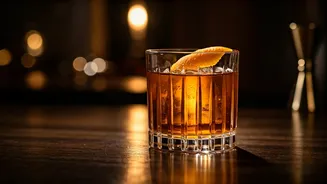
The best part about the Old Fashioned is that you don’t need a fancy bar to enjoy one. Its simplicity is its greatest strength. To make a great one at home, you only need four things. Start with a good whiskey—a spicy rye or a smooth bourbon works wonders. Next, a sugar cube or a small spoon of sugar syrup. Add two to three dashes of Angostura bitters directly onto the sugar. Muddle them together at the bottom of a sturdy glass until the sugar starts to dissolve. Add a large ice cube—the bigger, the better, as it melts slower—and pour over your whiskey (about 60ml). Stir gently for about 20-30 seconds. To finish, take a strip of orange peel, squeeze it over the drink to release its fragrant oils, rub it around the rim of the glass, and drop it in as a garnish. That’s it. No shaking, no fancy equipment. Just pure, simple elegance.